

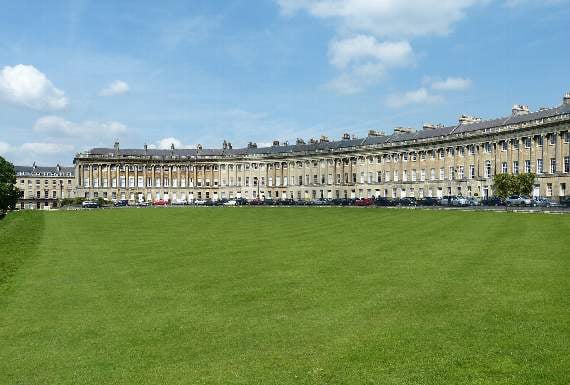
Air quality is improving in Bath, according to an official report.
Pollutants that contribute to heart disease and cancer are down by nearly a quarter in parts of the city, but congestion is causing issues in more rural areas.
An annual status report on harmful levels of nitrogen dioxide in Bath & North East Somerset found an average decrease of ten per cent in 2017 compared to the year before, when there was an eight per cent drop.
Concentrations dropped by 23 per cent in Lambridge, which the report put down to the extension of the bus lane to the A46 roundabout, and the location of queuing traffic away from the roadside.


In Keynsham High Street, there was a fifteen per cent decrease in nitrogen dioxide concentrations following the introduction of a trial one-way system, and in Saltford all the monitoring sites were below required levels. But new air quality management areas (AQMAs) are being imposed along the A37 in Temple Cloud and Farrington Gurney.
Temple Cloud with Cameley Parish Council Chairman, Tony Hooper, said: “Traffic levels along the A37 are so high. Two HGVs can’t pass each other between the Temple Inn and the doctors’ surgery, so they stop and sit there with their engines turning over. The pollution at the roadside is as high as 2.5 times the permissible level. It’s a noticeable issue.”
He said there had been calls for a bypass around Temple Cloud since 1945 but it seemed it was “no longer a priority”.
Cllr Hooper said he asked B&NES Council officers what their solution was, if not to reroute the A37, and was told that residents along it could put plants in their front garden to absorb the noxious gases. Parish councillors are set to be updated on options to improve air quality when they meet in September.
Nitrogen dioxide is recognised as a contributing factor in the onset of heart disease and cancer. Air pollution affects the most vulnerable – children and older people and those with heart and lung conditions.
B&NES Councillor, Les Kew, whose High Littleton ward includes Farrington Gurney, said changing the sequencing on the traffic lights at the junction of the A37 and the A362 would relieve congestion and improve air quality. He said this may have the knock-on effect of relieving congestion in Temple Cloud.
Councillor Bob Goodman, Cabinet Member for Development and Neighbourhoods, said: “The council takes the issue of air quality seriously throughout the whole of Bath & North East Somerset and is taking action as rapidly as possible.
“The main pollutant is road traffic, which is exacerbated in Bath with the city being set in a valley, which can trap the pollution.
“We are working on many measures, including the introduction of a charging clean air zone in the city, to rapidly improve the air we breathe, but this also relies on individual actions because each one of us has a responsibility to take action to improve air quality.”
An AQMA is not being declared in Whitchurch, but monitoring is continuing at key locations because concentrations of nitrogen dioxide are close to the objective limit. The area will be reviewed in 2019.
The report says monitoring sites in Saltford, Pensford, Bathampton, Radstock, Midsomer Norton, Westfield and High Littleton/Timsbury are below the 40ug/m3 objective limit.
Council leader Tim Warren said: “While it is welcome news that there is a decrease in the levels of nitrogen dioxide across the district, more work is needed to reduce these levels even further, because poor air quality is a serious public health risk to us all.
“We are working towards a cleaner Bath, but this means everyone using more sustainable ways to travel.”
B&NES Council has been tasked with improving air quality in Bath as quickly as possible. Its proposals include a clean air zone – which would see drivers of high-emission vehicles charged to enter the city centre. Three options are on the table and could include charges for residents’ cars.
The council has to make a decision by December and have a clean air zone in place by 2020.
Stephen Sumner
Comments
This article has no comments yet. Be the first to leave a comment.