

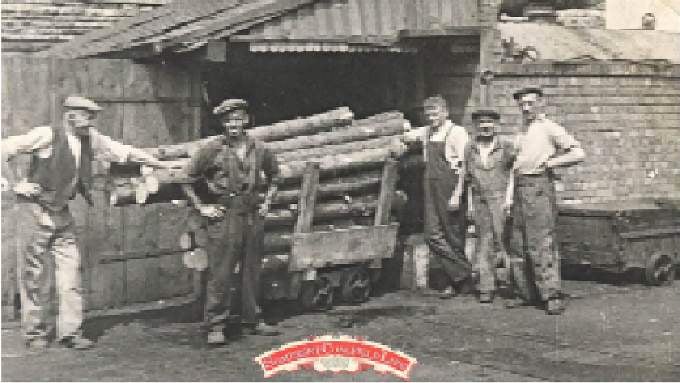
Thank you to those of you who had a go at the Mystery Photograph last week – it was supplied by reader Helen Gulliford, who had happy memories of walking past this house as a child. It was taken in Foxcote. Well done to: Tony Edwards, David Swift and Ian Beeho, who all gave correct answers. Radstock Museum have another Mystery for you to solve – “Men with pit props” – do you know who any of these local Miners are?
Lucy Tudor, from Radstock Museum, says: “Do any of the readers, especially former miners, recognise where this is? The stone walling in the background looks like Writhlington Colliery, but the brick and iron shed with wooden doors – we are not sure if this was attached to the colliery building at Writhlington or whether it is another colliery altogether.
“Timber pit props were grown and cut by Charlton’s Timber, which is how the company came to be in the first instance. Many of the local spoil heaps or batches were planted with fast growing pine trees which helped to stabilise the batches and also provided more pit props for the coal mines.
“The pit props were taken underground and cut to size with a square of wood wedged above and below the prop to hold up the roof of the coal seams underground.



“Once all the coal had been taken from one part of the coal seam, the props would be removed and reused for the next part of the seam. The space left by the removed coal was called ‘The Gob’ and was backfilled with rubble from blasting more tunnels to avoid having to take tons of useless rock up to the surface for dumping. But ‘The Gobs’ did often collapse, creating a gush of air and coal dust.
“For anyone wondering where miners went to the loo, I have been told by local miners that they would often pee into ‘The Gob’ – most miners managed to time number twos for before or after a shift BUT should the worst happen underground, a number two was apparently done onto a shovel and thrown into ‘The Gob’!
“Iron hydraulic pit props were introduced in later years, but they were heavy and awkward to carry and manoeuvre and were not popular with the miners preferring the wooden ones, which were also good at warning of the danger of a roof collapse by making creaking noises which the hydraulic props did not do.”
If you think you know where this week’s Mystery Photograph could be and would like a mention, please send us an email to: [email protected] by Monday at 5 pm.
Radstock Museum’s book and gift shop is open for Christmas Shopping on Saturday, 18th December from 11 am – 3 pm.
The shop is stocked with books on local history, railways, collieries, local villages, local walks books and much more.
There is also a good range of stocking filler toys and gifts for all ages, including mugs, coasters, note pads, ornaments, prints by local artists and more.
Annual gift tickets to the museum are also available so that you can give the gift of many free visits to the museum all through 2022.
For those who can’t pop in in person, mail order is available – go to: radstockmuseum.co.uk to see the range of items available and instructions on how to order, via email: [email protected].
The museum volunteers, Chairman, Simon Carter and Manager, Nick Turner would like to thank Journal readers for their support with information on the mystery photos this year and look forward to welcoming you all at the museum in 2022.
Comments
This article has no comments yet. Be the first to leave a comment.