

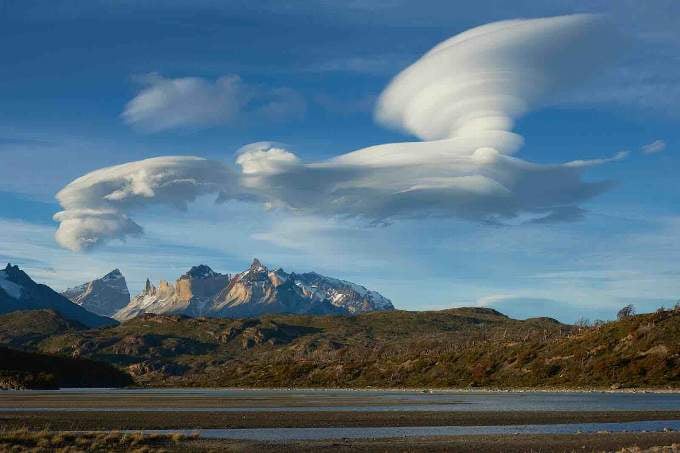
It was almost a full house of NRPS members that tuned into our regular Thursday Zoom for the much-anticipated return of popular speaker, Jeremy Richards.
It had been a year since we had enjoyed part one of his presentation on his travels in Chile, a country that extends more than 6,000km north-south along the Pacific coastline from Peru to the Magellan Straits. This time his travelogue took us from the middle regions to the ice fields at the very tip of the South American land mass.
Chile is a country of contrasts, of islands and volcanoes, plateaux and parks, with a history of exploration, Darwinian discovery and European settlement as well as dictatorship and fear of invasion. Living for four years in a photographer’s dream, Jeremy has recorded his many travels to the nether regions of this fascinating place, and it was more of these he shared with us on Thursday.
We travelled west across the ocean and enjoyed a fleeting look at the main island of the Juan Fernandez Archipelago, otherwise known as Robinson Crusoe Island, and went even further west to Pascua Hanga Roa, renowned as Easter Island, and famed for its thousand-year-old Polynesian settlement, and its 15th century statues, thought to have been erected to guard the island. Both islands rise from the ocean as a result of volcanic activity, now dormant, and contrast starkly with the mainland vistas, where more recent volcanic activity shapes and changes the landscape regularly.

We travelled south from Valparaiso through the beauty of the National Parks that everywhere abound, to the Chilean Lake District, where Lutheran Churches nestle round inland lakes, against an ever-present background of snow-capped, volcanic cones. The cultural centres that exist here are well established and boast museums and opera houses. These settlements are further enhanced gastronomically by the cakes of the Germanic settlers, as well as visually by the colourful boats, dragged or driven up onto the black, volcanic beaches.
These are the mainstay of the thriving fishing industry that feeds the larger cities, including the capital, Santiago. Conquistadors settled here, often at the confluence of rivers that spill down from the mountains. There is a pleasing eclectic mix of old and new, as traditional farmers and tradesmen, largely indifferent to the ever present threat of earthquakes, patiently and resolutely restore the old style wooden buildings whenever required.
There was huge variety in all we saw. Whilst some areas were devoid of trees or birds, others teemed with Penguins and Sea Otters. The further south we went, the more rugged everything appeared and the rusting wrecks of the unfortunate languished in the shallows of the straits.
Jeremy’s photos had something for everyone, from the glory of the granite spires to the cacophony of the King Cormorants, the colours of the glacial lakes and rivers and the curves of the rock formations in land and seascapes carved by glaciers.
None of us were disappointed by an evening of art, architecture, archaeology and astounding photographs, by an expert in the field who will always be welcomed back to NRPS to share another journey!
Jenny Short
Comments
This article has no comments yet. Be the first to leave a comment.