
Clutton History Group’s second Zoom talk took place on Tuesday, 9th February but with a change of speaker. Due to a computer malfunction the advertised speaker was unable to present his talk but luckily we were able to get John Page to bring forward his April presentation for which we were very grateful.
 Speaker's botanical expertise captivate members
 Royal United Hospitals Bath: how long patients waited for NHS treatment in OctoberUniversity Hospitals of Bristol and Weston: how long patients waited for NHS treatment in October
 Less than three in five A&E arrivals at Royal United Hospitals Bath seen within four hours
John’s talk was titled ‘Lighthouses of the Bristol Channel’. John began his talk with the lighthouses of Somerset. They are one at Hinkley Point, three at Burnham, two at Clevedon, and one, not strictly in Somerset, but an important one on Flat Holm. There is also one at Black Nore Point in Portishead. A light at Avonmouth was demolished when the dock was built. Lighthouses are there, of course, as a warning to shipping and as a navigational aid but as Daniel Defoe stated that the land with its rocks and sand banks and not the sea that makes a storm lethal to ships. Also it was not uncommon that smugglers would deliberately use lights to lure ships onto rocks to steal their cargo.
As well as lights there were also other markers such as Church towers which were painted white. Lighthouses were built on shore or off shore with off shore ones generally built on small islands or rocks. In the Bristol Channel, which was called the Severn Sea on old maps, there was a light at St Nicholas Chapel in Ilfracombe. This was the oldest example of a tower light and was in use in medieval times and in those days the light came from fires. The first light at St Anne’s Head was built in 1662 and was coal fired. Due to problems collecting charges to ships entering the port the lighthouse was pulled down. This led to a number of ships being wrecked so Trinity House house realising the need for a light granted a patent and two towers were built, also coal fired. In 1844 the current lighthouse was built.
On Flat Holm local people had to agree to the building of a lighthouse, to run it and apply for a Government patent. Merchants and traders from Bristol who wanted a lighthouse on Flat Holm couldn’t get the necessary agreements until in 1735 a ship with 60 soldiers on board was wrecked. When the lighthouse was built it was coal fired with coal from Swansea. At Burnham legend had it that a woman put a lighted candle in a window to guide her fisherman husband home. Due to it’s success she was asked to do it permanently. However, this story was disputed and in 1846 newspapers stated that the first light was lit by a person on Stert Island.
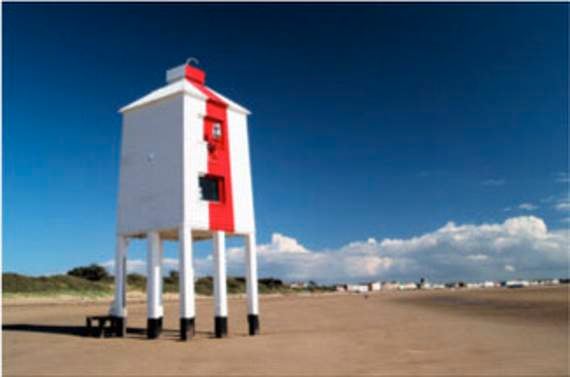
The first proper lighthouse was a tower built next to the church in 1801. A second tall tower was built at the end of the Channel and because of a blind spot a third was erected on the beach. This one, standing on legs, is probably the best known today and is still in use with remotely controlled lights. In 1794 the Mumbles lighthouse had two levels of lights, lit either by bonfires or candles.
Improvements in lighting gradually came with oil lamps, reflectors behind the lamp and the Argand lamp which had air flow through the lamp making it more efficient. Then came large lenses at the front of the light and eventually to the Fresnel lens. Trinity House laid down quite strict rules to operating off shore lights. Originally two keepers were employed but after one tragic incident things were changed. On one occasion one of the keepers died and the other one was so worried that he might be accused of murder that he took the body and hung it outside the lighthouse in a bag to prove that his colleague had died of natural causes. After that there were four keepers per lighthouse, 3 on duty and one on leave. They were a principal keeper, an assistant and a supernumerary or trainee. Part of their duties were keeping a log, taking wind speed measurements, visibility and barometric pressure. They also recorded wind force which they guessed by how it felt on their cheek. The talk was very well researched and there was more to tell as time ran out. The next talk, by zoom, will be on Tuesday 9th March at 8pm when Michael Manson will be giving a presentation on ‘The Bristol Bridge Massacre of 1793’.
Comments
This article has no comments yet. Be the first to leave a comment.