

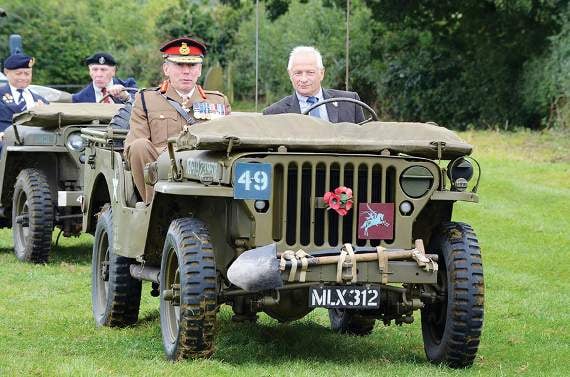
The Director of Double Hills Memorial, Peter Yeates, was seven-years-old on the morning of 17th September, 1944, when he saw the great armada of planes and gliders in the sky above, flying over his hometown of Midsomer Norton.
All aircraft were heading for Arnhem. Word quickly spread amongst the children in the village that a Horsa glider had crashed in a field at Paulton. At seven-years-old, Peter was not allowed anywhere near the crash site, but the memory of that day remained with him for the years to come.
Peter and his family moved to the village of Hallatrow in the 1970s. After reading about the crash again in the book A Bridge Too Far, Peter decided to fulfil a lifelong ambition to do something towards the memory of the 23 men who died near Paulton, to ensure that they would never be forgotten.
A working committee was set up, which included Bristol ex-Royal Engineers, the President of the Royal British Legion in Somerset and veterans, Clifford Ashman, Keith Ford, Fred Ponsford – a Glider Pilot – and local village residents, who all gave their full support to this cause.


It is, therefore, thanks to Peter and his passionate ambition that in 1979, Major General R.E. Urquhart, Commander of the First British Airborne Division at Arnhem in 1944, unveiled and dedicated the Double Hills Memorial that stands there today.
On Sunday, 17th September, 1944, at 10.25 a.m., RAF tug-aircraft, Stirling LK 148 from RAF 299 Squadron, 38 Group, took off from RAF Keevil, Wiltshire. In tow was Horsa Glider Mk1, RJ113 (Chalk No. 389) piloted by S/Sgt. L. (Len) J. Gardner and his co-pilot, Sgt. R. (Bob) A. Fraser.
On board the Horsa Glider was a complement of 21 Royal Engineers. They took a course northwest towards Gloucester to form up with a stream from RAF Fairford and then headed out over the Severn and Bristol Channel to join the main stream of tugs and gliders. All were heading towards the English coast en route to Arnhem.
At approximately 11.05 a.m. over the village of Farrington Gurney, an explosion occurred in the Horsa glider. The tail had been blasted from the fuselage; the glider then lost lift, hurtling to earth, breaking the tow rope. It crashed into the fields called Double Hills, killing all on board.
Members of the crew on board the RAF Stirling tug-aircraft described the scene. Wally Simpson was watching the Horsa glider trailing behind. Horrified, Simpson shouted to the Stirling Captain: “My God, the glider’s coming apart!” The front of the Horsa glider sank to earth like a falling rock.
After circling endlessly, the RAF Stirling aircraft crew were able to log the crash site before returning to the RAF Keevil airfield base, where the crew grabbed a jeep and drove the 22 miles back to Paulton. Upon arrival back at the crash site, RAF Flt. Sgt. Ken Crowther said: “I saw a scene of carnage, the likes of which I hope never to see again.” Recalling the event in later years, he said: “Time passes – I was 21 then, and didn’t ever want to come to Double Hills again, but I came to live locally, joined the Double Hills Memorial committee and am so glad that the chaps are now remembered.”
The RAF tug-aircraft Stirling LK148 and crew went to Arnhem the following day after the horrific crash to carry out a supply drop mission. It was hit by flak and crashed near Driel, Holland. Wally Simpson dragged Ken Crowther and other crew members from the wreckage. Ken lost a foot; an injury from this crash which caused him pain to the end of his life.
The men that died at Double Hills were Airborne Royal Engineers, mostly regulars at the start of WW2, who had fought in North Africa, Sicily and then trained endlessly during the summer of 1944 in preparation for Arnhem.
Two Horsa glider pilots from the elite WW2 regiment, the Glider Pilot Regiment, also lost their lives at the horrific crash site known as Double Hills on 17th September, 1944: Staff Sergeant Leonard Jack Gardner, and Sergeant Robert Augustine Fraser.
The police, Home Guard and ambulance crews recovered all the bodies that day. The two Glider Pilots and 21 Sappers were all buried with full military honours in the Milton Road cemetery, Weston-super-Mare, and are today widely acknowledged as the first casualties of the ill-fated Operation Market Garden and epic Battle of Arnhem.
Subsequent research into the cause of the Horsa Glider crash over the years has proved inconclusive. Whilst there were a number of eye witness accounts, enquiries made to the Records Office in the late 1970s revealed that the accident records had been destroyed. However, comment was made that the crash was “likely to have been caused by structural failure”.
This was as a result of sudden jerking and oscillation in flight whilst the glider was fully intact, causing the tail section to break and fall away. This also caused the fabric to disintegrate from around the fuselage. Eye witnesses mention “bits falling off” or “large bits of paper-like material floating down after the tail parted”.
The witness accounts of explosions occurred after the glider had hit the ground and the ammunition or explosives carried by the Royal Engineers on board detonated. Local people who rushed to assist the stricken glider on the ground were also injured from these blasts. The probable cause of the crash was therefore structural failure.
Since 1979, the Double Hills Commemorations have been fully supported by veteran Glider Pilots who served in the elite WW2 Glider Pilot Regiment and the Glider Pilot Regimental Association. In 2016, the Regimental Association was wound down due to the declining number of veterans still alive.
In 2017, a new Glider Pilot Regiment Society was set up in its place to continue supporting those who served, and to preserve and promote the rich and varied heritage of the Regiment through education and media. A network is now in place for veterans of the Glider Pilot Regiment and their families to engage with one another for the purpose of remembrance, community and heritage. For details, email: [email protected]
Members from this Society will be in attendance at the 2018 Double Hills Event Commemoration, on Sunday, 2nd September at 2 p.m.
Comments
This article has no comments yet. Be the first to leave a comment.