

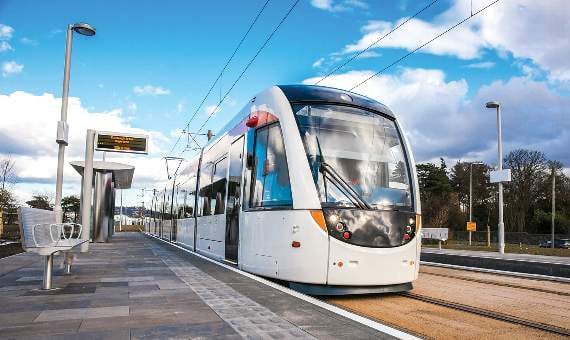
Commuters facing travel misery into Bath every day may be cheered by news that an initial study, looking at the feasibility of introducing a tram system into the city, has identified the A367 Odd Down corridor as having the strongest potential.
Residents travelling from the Somer Valley every day will probably agree with the assessment that out of all of the routes in to the city, the A367 is experiencing the highest amount of traffic. It is identified as having the strongest potential for a tram system, based on the potential travel demand and engineering and environmental constraints. The proximity to the Park and Ride site would also help its cause.
The report notes that current congestion is an issue in the city centre, and dissuading commuters to use public transport, only to be sat in queues. Trams, it is argued, could mean fewer cars, and in turn less congestion, pollution and noise – and, rather than detracting from the city as a World Heritage Site, it could very well attract further tourists.
Ultimately though, there needs to be a solution to move easily, speedily and cleanly around the city; something B&NES Council were beginning to address with the East of Bath Park and Ride plan. Interestingly, the report notes that the lack of a Park and Ride site here would be a major constraint to introducing trams from the East of the city, and a depot would also be needed near to the A4 Batheaston area. It states: ‘given the transport needs in this part of the city, serious consideration must be given to a package of measures to improve public transport in this corridor.’

The report looks at routes into the city centre from Lansdown, A46 Gloucester Road, A4 Batheaston, A363 Farleigh Wick, the A36 Warminster Road, A367 Odd Down, A4/A36 Newbridge, the A431 Kelston and Bathwick Hill.
It also looks at how light rail or a tram network could be powered; such as supercapacitors (capable of climbing steep gradients and preferable for the World Heritage status but also very expensive); batteries, groundfeed or hydrogen power. It notes ‘significant’ technical challenges to deliver a dual-voltage light rail tram-train. Other factors that would need to be considered are stations and stops, turning and gradients, the environment, lighting, ticket machines, CCTV, signalling and points heating equipment, and independent power supplies along the route. An important consideration will also be whether or not the city, with its vaulted streets, could cope with light rail vehicles, which typically weigh around twenty tonnes.
So, what about the cost? Current systems across the UK have varied in price, with today’s costs being anything between £180million to £340million for the system alone and £190m – £410m for extensions, with most of these based on historic rail and tram routes, which reduced cost.
The Local Authority usually has a stake in the Operating Company.
Much more work will need to be done in investigating this idea, including development of a network, detailed analysis of potential demand, revenue forecasting; a potential redesign of the bus network, identifying potential costs and financial viability and looking at the wider economic and environmental benefits.
The study is due to be discussed by Councillors on the Communities, Transport and Environmental Policy and Development Scrutiny Panel next Monday, 22nd January.
Comments
This article has no comments yet. Be the first to leave a comment.