

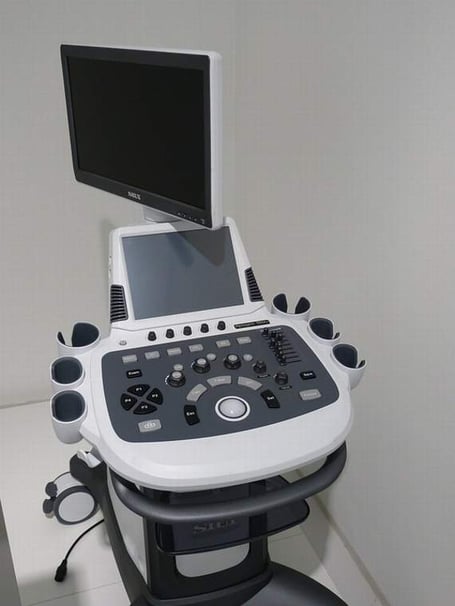
At the next Science in Radstock talk, Professor Francis Duck will explain all about ultrasound.
Ultrasound is produced in nature by bats and dolphins, used for medical scanning and treatment, for bird scarers, decorative fountains, proximity detectors, metal testing and chemical processing. The word ultrasound refers to any sound that is too high in pitch to be heard, above 20 kHz in frequency.
The talk will give a gentle overview of the history and development of ultrasound, starting with the first investigations of the upper limits to human hearing at the end of the 1900s using tiny tuning forks and whistles. The first practical application was to detect German submarines during the 1914-18 war and the technology was quickly adapted to depth sounding. Medical scanning developed after the Second World War.
Nowadays about ten million ultrasound scans are carried out in English NHS hospitals each year. Besides baby scanning, it is used to investigate heart disease, faulty arteries and veins, cancers and blockages in the liver and kidneys and lumps in the breast. Small, inexpensive, battery-powered scanners have extended the availability of equipment, so ultrasound is now as widely used as X-rays, especially in more remote hospitals in the developing world.
 Speaker's botanical expertise captivate members
 Royal United Hospitals Bath: how long patients waited for NHS treatment in OctoberUniversity Hospitals of Bristol and Weston: how long patients waited for NHS treatment in October
 Less than three in five A&E arrivals at Royal United Hospitals Bath seen within four hours
Francis Duck started work in medical ultrasound at University College Hospital, London, in 1966. He eventually settled in Bath in 1976, working on ultrasound at the Royal United Hospital and Bath University until his retirement in 2011. He is now exploring the history of physics in medicine, and has published books on the topic. He was awarded the MBE for Services to Health Care in 2007.
Science in Radstock is the series of popular science talks organised by volunteers at Radstock Museum. This next talk will take place at Radstock Working Men’s Club on Tuesday, 17th March at 7.30 p.m. All are welcome.
Read more at: http:// radstockmuseum.co.uk/whats-on/our-talks-programme/
Comments
This article has no comments yet. Be the first to leave a comment.