

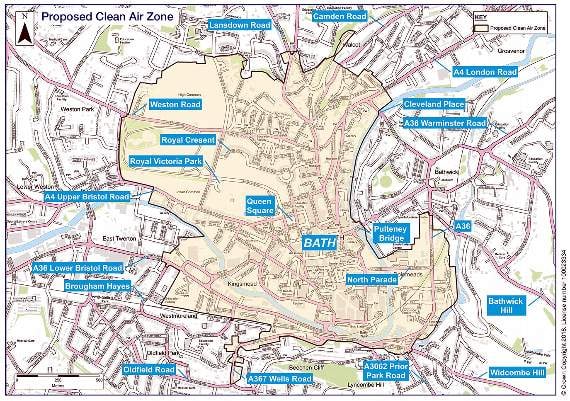
Measures must be taken to soften the impact of the proposed Bath Clean Air Zone, according to backbench Councillors on a Council watchdog committee.
B&NES Council is looking to introduce a clean air zone that will see drivers of high-polluting cars, vans and taxis charged £9 and non-compliant buses, coaches and lorries charged £100 from late 2020. The income is expected to average £5.6 million a year over a decade.
The Council’s Communities, Transport and Environment panel met last week to carry out in-depth scrutiny of the Clean Air Zone (CAZ) scheme. Panel members concluded that there are at least half a dozen issues requiring more attention before the CAZ becomes workable for residents.
Councillors put officers and Cabinet members on the spot with detailed questions. They eventually agreed on a list of requests for improvements, which will now go forward to the Cabinet. These included more work on preventing rat-running, the proposals around financial assistance for residents and businesses, and improvements to public transport.
 Royal United Hospitals Bath: how long patients waited for NHS treatment in OctoberUniversity Hospitals of Bristol and Weston: how long patients waited for NHS treatment in October
 Less than three in five A&E arrivals at Royal United Hospitals Bath seen within four hoursJust two-thirds of A&E arrivals at the University Hospitals of Bristol and Weston seen within four hours
Lib-Dem Environment spokesperson, Councillor Richard Samuel, commented: “We want to see practical measures to ensure that unaffordable costs don’t fall on those least able to pay and to protect local businesses and the local economy. At this stage, we haven’t seen enough detail on some of the big problems, such as preventing and mitigating rat-running.
“We were also shocked to learn that the Government intends to claw back ten percent of the income from the zone. This stealth tax is a real concern. It will limit the Council’s ability to invest in sustainable transport improvements locally, reducing its ability to mitigate the impact of the CAZ.”
Wera Hobhouse, Bath’s Liberal Democrat MP, said: “This was central Government’s problem that they pushed on to local councils, and now they want ten percent back from us.
“This money would be better spent on public transport and cycle infrastructure in Bath, rather than getting lost in central government. The money from the Clean Air Zone should be invested in Bath’s future. I will be taking this up with the Minister.”
Transport spokesperson for the Lib-Dems, Councillor Neil Butters, added: “I’m concerned that the CAZ will not work unless we see significant improvements to the local bus network. Longer opening hours for the Park and Ride are welcome, but there are other services which need to be considered. We heard last night how there are insufficient links to the RUH, and how some communities have no bus service at all.
“We want to see a more proactive attitude towards buses locally, with better support from the West of England Combined Authority so that taking the bus becomes a viable alternative to the car.”
The introduction of clean air zones was triggered by legal action against the Government by campaign group, ClientEarth. The legal limit for nitrogen dioxide is forty microgrammes per cubic metre but in some areas, like London Road and Lower Bristol Road, it is as high as 68 microgrammes per cubic metre.
Environmental Protection and Licensing Manager, Cathryn Brown, said: “There are significant health issues around air pollution. We’ve had a directive from Defra because of ongoing exceedances of nitrogen dioxide levels. We aren’t alone. There were 28 other local authorities, now there are 61. We need to comply in the shortest time possible.”
Ms Brown said the exact consequences of not complying were unclear, but it could, along with any other Council that fails to meet the target, face a class action lawsuit. She said it could be fined or struggle to get Government funding in future, if it does not bring nitrogen dioxide levels within the legal limit.
Regarding the charges, Cllr Samuel told the Communities, Transport and Environment Scrutiny Panel on Monday, 29th October: “We have the most extraordinary situation. Central Government has imposed these restrictions and said we must do it. They’re giving us the opportunity to charge the public and clawing back ten per cent.
“This is outrageous. The Government has failed to comply with the European directive and now they expect residents to subsidise it. We’re paying for our own funerals.
“The very least you would expect is that the Government would pay for it after the cuts over the last eight years. This is really shocking economics.”
The results of the current consultation will be considered by Cabinet members on 18th December.
Stephen Sumner
Comments
This article has no comments yet. Be the first to leave a comment.