

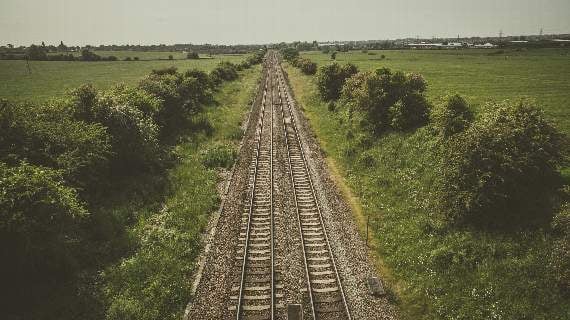
‘Remembering the Somerset and Dorset Railway’ was the topic of Clutton History Group’s November meeting given by Andrew Linham.
Andrew’s presentation was given in two parts; the first part being a history of the railway and it’s expansion, followed by his own original film footage of a journey across the Somerset levels and from Bath to Bournemouth.
The railway started life as the Somerset Central Railway, with a broad gauge line from Highbridge to Glastonbury, opened in 1854. It was run by the Bristol and Exeter Railway. Amongst the backers of the Somerset Central was James Clarke, who together with his brother, Cyrus, founded the Clarke shoe company.
In 1858, an extension was added to Burnham-on-Sea, where a slipway was built to allow access to ferries across the channel. In 1859, the Glastonbury to Wells line was opened.


In 1860, the fledgling Dorset Central Railway opened a line from Wimborne to Blandford, which was worked by the London and South West Railway. In 1862, the Dorset Central and the Somerset Central merged to become the Somerset and Dorset Railway (S&DR), and the two independent companies extended their lines to Cole in Somerset.
With a line built from Broadstone Junction to Poole, it meant that the S&DR could now run from coast to coast, which they hoped would attract substantial traffic, but unfortunately, this did not materialise. With the company in financial difficulty, a desperate attempt was made to lure extra traffic by opening a line from Evercreech to Bath, thereby linking up with the Midland Railway.
This gave access to the Midlands and the North and was very successful. However it came too late to save the company, so it was placed into receivership. In 1875, the company was taken over by the Midland Railway and the L&SWR and was renamed the Somerset and Dorset Joint Railway (S&DJR). Hereafter it was always affectionately referred to as the S&D, to some it was the ‘Slow and Dirty’, but to most as ‘Serene and Delightful’.
The line from Evercreech to Bath went through the Somerset coal fields, which was a good source of revenue for the company, but the line was always a challenging one – having to climb over the Mendip Hills where the gradient was generally one in fifty. The highest point was at Masbury at 811ft (247m) above sea level. One disadvantage of the S&D was that there were several sections of single line working, and to ensure that only one train would be able to run on a single line section at a time, a system of tokens was used.
At each signal box at the end of a single line section, token machines were installed, electrically linked so that only one token could be removed at any one time. When a token was taken from one of the machines, both machines at each end became locked. The token was then attached to a metal hoop, and at the entry to the section, the token was then collected, on the move, from the signalman by the engineman.
At the end of the section, the token was collected by the signal man, placed in his machine which unlocked it, and the line was then free to accept the next train. In later years, the Whitaker mechanical lineside apparatus was installed, which allowed trains to collect the tokens at 40mph – thereby speeding up the whole operation.
The S&DJR was at its most popular in the late 1950s and early 1960s, particularly with holiday traffic from the North and Midlands. The Pines Express from Manchester to Bournemouth was ever popular, and was hauled on some occasions by unusual combinations of motive power. This was a particular attraction of the S&DJR to rail enthusiasts, especially when most heavy trains were double-headed and had to work hard on the one in fifty gradient. Engines from the Midland and Southern regions of British Rail were common sights on the line.
At the end of the 1950s, the Somerset coalfields were becoming less productive, and several of the small branch lines became uneconomic and were closed. The Pines Express was re-routed in 1962 by other routes, and closure of the S&DJR was
announced in 1966 under the Beeching Axe.
Today the S&DJR is being kept alive by dedicated enthusiasts who are restoring locomotives and stations and track-laying continues at various sites on the old track bed. Notable sites are, locally, at Midsomer Norton, and at Washford on the West
Somerset Railway.
The Group’s next meeting in the village hall will be on Tuesday, 12th December at 8 p.m., when John Dando is the speaker with a humourous talk entitled ‘Privvies – a walk up the garden path’. This will be the group’s Christmas meeting, with festive eats and drink available and a raffle in aid of Children’s Hospice South West. For further information please telephone: 01761 471533.
Terry McGill
Comments
This article has no comments yet. Be the first to leave a comment.