
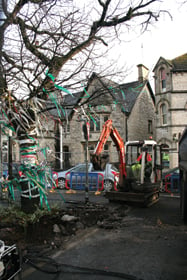
Many man-hours and not a few thousand pounds have been committed to relocating Queen Victoria's Diamond Jubilee Oak from the centre of Radstock to a sportsfield at Writhlington.
Work commenced on Monday, 3rd December and on Sunday, with the help of specialist equipment, the tree was finally extracted to be taken up Frome Road to Writhlington. The tree was eventually planted, and workmen can be seen, left, putting the final touches to the base.
Comments from RAG
"Watching the Jubilee Oak being removed from Radstock was not for the faint-hearted," comments Amanda Leon, Secretary of the Radstock Action Group.


Before daylight, on Sunday, 9th December, the B&NES contractor, Glendale Civic Trees, arrived to set about taking away a well-known landmark. Radstock Action Group gave them a letter asking them not to as the legal situation was not in order. But, for the man-in-charge, he was just doing as told by B&NES Council who had assured him that all the necessary consents were in place. Not so, claims RAG. The legal situation, as understood by RAG, can be found at the end of this statement.
"For those who watched, each stage was more painful than the last. First, the taking hold of the trunk in a massive clamp-like structure attached to a trailer/truck, then actually getting the tree out of the ground, including hacking away at the root ball, then hoisting it onto the truck for a precarious removal to Writhlington. The hole had been dug, but the tree was delayed as there was a danger that power lines would be hit and branches had to be sawn off. But then the tree wouldn't fit the hole so, yes, they sawed off more of the roots. Spectators left before the end, they had no stomach for this violence.
"It seems highly unlikely the tree will survive, perched as it is on its now diminished rootball, in a windy spot quite at odds with its longstanding home in a valley, fed by numerous water courses. A look inside the hole revealed that the soil is clay and stony.
"You could not be other than shocked – however tough you thought you were ...," concluded Amanda.
New Road still opposed
The much bigger question is the road which B&NES wants to put through the middle of the town and for which the Oak has been sacrificed.
Radstock Action Group wants regeneration, as does everyone in the town, but the removal of key features of the historic centre and the introduction of main-road, through traffic into the shopping streets will not achieve this end, RAG believes.
"B&NES must listen to the people who know best - the people who live and work in Radstock and the many who visit for the town's outstanding access to beautiful countryside, its renowned town centre and museum, its varied and friendly shops, its pubs and range of eateries.
"Radstock needs good homes and jobs for local people, but it seems that B&NES is happy to reduce it to a bland commuter suburb for Bath, devoid of all its history and individuality," thinks RAG.
RAG's legal argument
The tree stood in a conservation area (a legal planning status) and, without a consent to the contrary, was protected by being so located. Without a valid permission to which a contract for development is linked, the tree was protected. Its removal poses a series of questions about the legality/illegality of such action.
Can a Conservation Area consent be considered valid when the original consent has expired (on 4th June 2011) but been kept 'live' by means of an application for an extension of time, when that extension has not been determined a year and a half later?
If not, does the length of time indicate that there isn't an intention to consider the extension?
A condition of the conservation area consent is that no demolition shall take place until a contract has been let for the development of the site in accordance with a valid planning permission. There appears to be no such contract and no valid planning permission.
If the Bellway contract still legally exists, it is linked to an outline consent that has effectively been superseded and is not expected to be progressed.
If there is such a a contract with Linden Homes, it must surely be based upon the extension application for the same plan?
The Conservation Area consent itself was linked to the outline consent, which now appears invalid and is not actionable, in which the permitted highway scheme (in the S.106 agreement) is significantly different from the modified highway scheme permitted in the subsequent Road Traffic Order – i.e. it is a different road scheme.
ED: In the past everyone said the people of Radstock were wrong. The Bellway traffic proposals would be fine. B&NES Highways, rather than Bellway's Traffic Consultants, came with a new scheme, which would be better, they believed, for Radstock.
That change, if approved, means an important part of the NRR scheme will have to be redesigned.
Everyone knows this, but B&NES appears to be maintaining the fiction that the old scheme, extended, is still valid. No wonder people find it difficult to trust B&NES Council.