.jpg?width=94&height=94&crop=1:1,smart&quality=75)

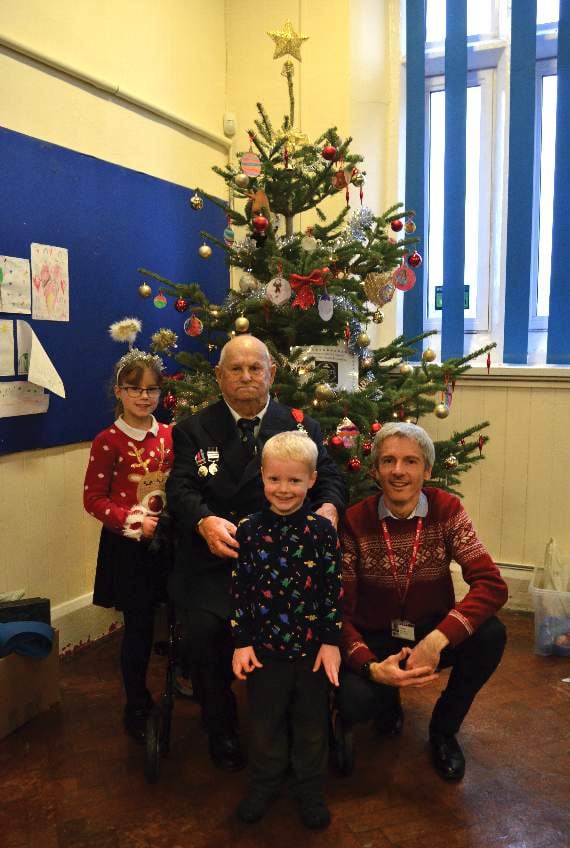
A very special guest joined Welton Primary School on Tuesday this week. Albert Fenton, a World War ll Veteran, and his son, Andrew Fenton, visited the local school that two of his great-grandchildren attend to tell pupils about his life, both during and post-war.
John Snell, Headteacher, told The Journal how excited they all were that Albert was able to visit and educate them all on his personal account in the war as part of their learning.
Mr Fenton, who was born in Bath on September, 11th, 1925, reminisces about his life and memory of the Blitz. He says: “I was seventeen when the Bath Blitz occurred. This was a raid by the German Luftwaffe on Bath in April,1942, part of the Baedeker Raids.
“The raid left 417 dead and more than 12,000 injured. My brother, Will, was serving in the Merchant Navy and my brother, Les, was in the Royal Artillery at the time.


“Heavy bombs were being dropped all night long so none of us got any sleep at all.
“An air raid warden came to visit us later that day and told everyone in the flats to leave.
“The bombing started again that evening; this time, it was mainly incendiary bombs, which are designed to start fires or destroy. It was these bombs that razed the Trinity Church to the ground.
“I was called up to serve in 1943 at the age of eighteen to do six weeks training at what is now Butlins, Skegness.
“I was trained as a driver on many vehicles, including what they called ‘Ducks’, which were lorries that could go on both land and water – that was a good job, as I never had to take a driving test and have not taken one to this day.
“Our first job was to serve all of the South-East coast (Black Down) on Salisbury Plain. We had to assist the Americans and the Canadians by keeping them supplied with petrol, food and vegetables.
“I was one of the youngest soldiers, at the age of eighteen, serving with the R.A.S.C. I remember waiting at Black Down for about three weeks for the day that we were to be sent off to war.
“We sailed early on June 6th,1944, not knowing where we were going or what was lying ahead of us. When we arrived at Juno Beach in Courseulles-de-Mer, we had to stay on board until a new road was laid out for us.
“From here, we went to Arromanches, where we stayed for about six weeks, advancing as our troops moved further up the mainland.
“We moved supplies and stores to Bayeux and then to Armeine. After this, we moved to the outskirts of Antwerp, where all of our trucks were on standby.
“A few days following this, we were all called to stop everything that we were doing and just follow orders. We were told to load our trucks. We had to travel through the night in complete darkness, with no headlights at all. None of us knew where we were going or what to expect.
“There were hundreds of lorries everywhere when our commanding officer told us our worst nightmare – that we were at Bergen Belsen Concentration Camp.
“The first thing you noticed when stepping out of the truck was the horrible stench in the air. It was like nothing I had ever experienced before but was horrid. We could see the furnaces burning at the far camp. There were four altogether, but they were using the first one as a hospital, which was filled with Jews that had arrived the previous day from work camps.
“It was then that we found out that our next job was to transport these people to a new destination. We heard that there were over 60,000 prisoners held in Belsen, and 50,000 of these were dead.”
In his autobiography, Albert explains his experiences with the end of the War: “It was here that we heard that the Germans had surrendered, and the War was finally over. We had won.
“We moved back into France and about ten of us were told that we were going back to England. On the way back, we were told that we needed to take our trucks on to the embankment because of an oncoming vehicle. To our amazement, a lorry containing the British General, Mont- gomery, and King George V was on the opposite side.
“As the Duck pulled out to pass us, King George raised his hand in gesture to us and mouthed the words, ‘Thank You’. Without hesitating, I raised my hand and saluted him.”
Albert recalled it was at this point that they found out that they would not be going home, but instead, were being sent to Egypt to take military supplies from Alexandra to Cairo.
“I was eventually demobbed from Palestine on 22nd August, 1947 and sent to Aldershot to collect my demob kit. We were given six weeks leave and six weeks pay, which amounted to fourteen shillings a week.
“I was twenty-three-years-old when I returned to Kingsmead Flats to my mum. I got my first job back home working for Gage’s Dairy at Bathford. It was while I was there that I met Gwendoline (Gwen) Hall.
“She was only fifteen at the time, and living in Box with her family. Originally coming from North Kensington, London, she was among all the children that were evacuated and sent to small villages around Bath.
"We were eventually married at Melksham Registry Office on 14th September 1950.
“Our first son, Phillip, was born on January 14th, 1952, followed by five more children over the span of eighteen years.
“I decided to take redundancy from Stothert and Pitt’s in 1978, finishing at Victoria Works at the bottom of Brougham Hayes after spending over twenty-five years of my life there.
“It wasn’t long before W.H.Smith offered me a full-time position with them. I carried on working for Smiths until I retired in 1988 at sixty-five, serving twenty-five years. I think I was probably about seventy when I finally put my working boots to rest for good.”
Andrew, Albert’s son, spoke to The Journal: “We go to Normandy every year for five
days to attend the D-Day celebrations on 6th June. Albert loves to go and be part of everything, and visit all of the cemeteries. It is really important to do that with him.”
Albert adds: “About eight years ago, in 2011, I went to Southsea with my wife for a short break.
“Sitting on a bench by the sea, we were joined by a few more Veterans. After telling them that I landed on Juno Beach and worked with the Canadians, one of the men pointed to another bench opposite ours and told me that I should go over and talk to the three men that were sat there, as they were Canadian veterans.
“I sat with these men for several minutes, shaking hands and talking about our experiences in France. I had just finished telling them about the Canadian that I had become friends with and that all I could remember was his first name.
“To my greatest surprise, the man boldly stood up in front of me, held his hand out for mine and looked at me with a tear in his eye and said ‘Hello Bert, my name is Tom, I am the young soldier that smoked your cigarettes.’
“After over fifty years, never did we dream that we would ever see each other again. With so much to talk about and so little time, it was very over-whelming and emotional for both of us.
“We chatted non-stop for hours and swapped email addresses. With tears in our eyes, we finally said our goodbyes. I will never forget this man and our chance meeting.”
Now, six children, over sev- enty grandchildren and great grandchildren later, Albert is living with his son, Andrew, and his daughter, Debbie, who has been his full-time carer since Gwen sadly died in 2015.
Albert plans to continue his tour of the local Primary Schools, with the help of his son, Andrew.
Comments
This article has no comments yet. Be the first to leave a comment.