.jpg?width=94&height=94&crop=1:1,smart&quality=75)

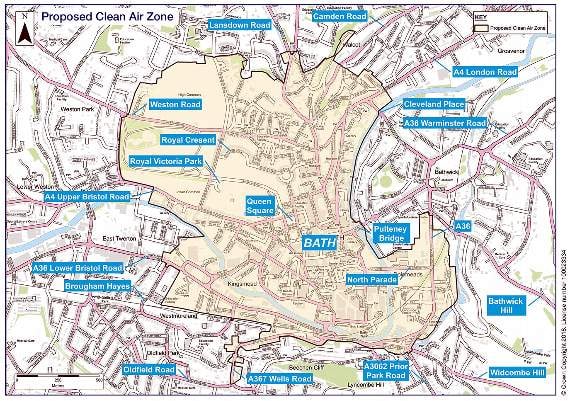
Following pressure from the residents and opposition parties, the Liberal Democrat administration have been forced to renew the commitment not to charge private cars entering the Clean Air Zone (CAZ) at last week’s Cabinet and Council Meeting.
The turnaround came in response to growing resident concern, particularly in North East Somerset, over what the new B&NES Liberal Democrat administration’s intentions are over Clean Air going forward.
Most people thought that given that the previous Conservative administration had decided on 5th March 2019 not to charge cars, that the matter was closed. However, it still remains unclear why then the Lib-Dems are reopening the debate at a cost of an estimated £100,000 to local taxpayers at time when there is so much financial pressure in B&NES.
Council Leader, Dine Romero, said on BBC Radio Bristol back in May that she was going to re-examine the conclusion not to charge cars made by the Conservative administration, as she questions the validity.



B&NES has actually done a huge amount of consultation on this issue. Public consultation opened on 16th October 2018 for a period of six weeks, based on the option of a charging Class D Clean Air Zone (CAZ) charging all vehicles. The public came back with a record 8,500 responses expressing their views.
Work was then undertaken to process the outcome of the consultation and prepare a revised, final Outline Business Case for the delivery of the CAZ. A revised Outline Business Case further assessing the shortlist of options proposed a revised package of measures, including a revised class of Clean Air Zone which will still bring about compliance in the shortest time possible in Bath. It also included further details about how the scheme would be implemented and the revised funding bid to central government to ensure successful implementation of the CAZ.
Cllr Paul Myers, B&NES Midsomer Norton Redfield and Leader of the Conservative Group, told The Journal: “This is a great victory for common sense, given the massive social and economic impact of charging cars which would have hit at two levels. Firstly, for residents on low incomes, measures to achieve clean air cannot be allowed to be disproportionally impacted on them. Imposing charges to enter the City of Bath/travel to the motorway on all cars would have, in my view, had a catastrophic impact on those least able to pay.
“Equally, for businesses in all sectors located in the city – and in particular, those in the retail sector already facing pressures, the imposition of significant charges on cars entering the city, would have had a double impact. Customers, I fear, would have been discouraged from coming into the City at all, and costs for staff would have impacted the labour market.
“For many, the measures decided on 5th March seemed to be based on sound statistical thinking and as well as achieving clean air targets would allow us to maintain the life, operation and economic vitality of not just Bath, but also the thousands of people in North East Somerset.
“I am acutely aware that the Lib-Dems, by indicating that they intend to re-open the Clean Air debate, are wasting money.”
Bath & North East Somerset Council leader, Councillor Dine Romero, said the evaluation of work to date would ensure there were no missed opportunities ahead of the introduction of the zone by 2021, and confirmed that cars would not be charged to enter it.
“We are on track for a consultation early in the autumn on the draft charging order, which will form the legal basis for enforcing the zone when it is launched by 2021.
“We will also be talking to people about a substantial package of financial and practical support for businesses and communities affected by the charge, which includes £35 million for interest-free loans and grants to help businesses upgrade non-compliant vehicles and to install electric charging points.
“However, before we finalise these, we are taking a look at all the work that has been done to date, to make sure we have a scheme that not only delivers clean air and improves health outcomes but also addresses Bath city centre transport issues.”
Councillor Sarah Warren, cabinet member for Climate Emergency and Neighbourhood Services, added: “It is important that we do not miss any opportunities to build on the Clean Air Zone by making links to our declaration on Climate Emergency. This is why we are undertaking a quick look again at the technical work, so we can be assured of its robustness in ensuring that NO2 targets are met in the shortest possible time while tackling carbon emissions.”
The Class C CAZ will see daily charges for all higher emission vehicles (except private cars) to drive in the zone to urgently reduce harmful levels of nitrogen dioxide (NO2) pollution by 2021 at the latest.
Comments
This article has no comments yet. Be the first to leave a comment.