.jpg?width=94&height=94&crop=1:1,smart&quality=75)

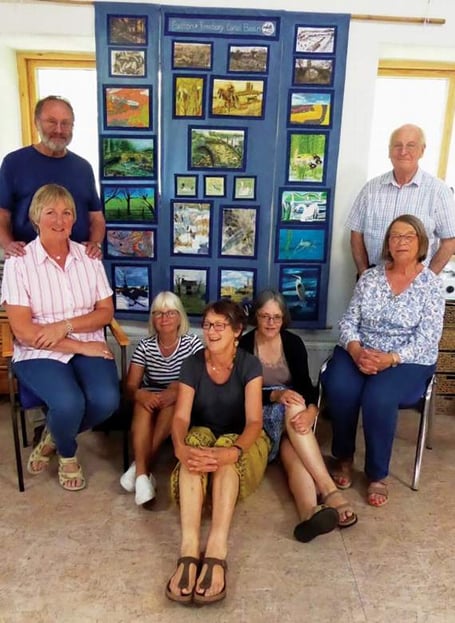
In January 2019, ten local people came together to create an art project entitled, “Then and Now,” dedicated to celebrating the canal basins.
Local art tutor and batik artist, Shelagh Hetreed, was commissioned by The Natural Theatre Company to create a piece of work related to the Cam Valley, through which runs the remains of the Somerset Coal Canal and the Cam Brook, (the river from which the Somerset Coal Canal took its water).
Shelagh gathered a group of four men and six women to form an art group. It is their first combined work.


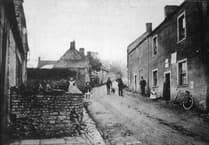
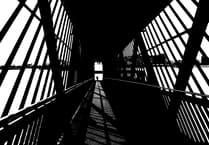
The banner consists of twenty-two individual pieces of artwork, ranging from historical photographs to interpretations of ‘then’ and ‘now’. The techniques learned and used include: batik, screen-printing, cross-stitch, embroidery, appliqué, quilting and sketching.
The inspiration for the artworks comes from the Paulton and Timsbury basins of the former Somerset Coal Canal.
These basins lie on the northeast side of Paulton, and can be accessed along the Limestone Way public footpath. Today, they resemble three long ponds full of wildlife, including swans, ducks, coots and moorhens, as well as frogs and visiting birds, including herons.
They are a haven of peace and tranquillity for local people and visitors, and a brilliant area of conservation that also teems with reminders of its fascinating industrial past.
Before the Somersetshire Coal Canal was built in the late 1700s, mines in the Somerset Coalfields transported coal to Bath and Wiltshire by horse and cart or packhorse.
Only limited quantities could be transported this way, and with poor roads, steep hills and much flooding in the winter months, a new and more cost-effective way had to be found to move the coal.
In 1794 an Act of Parliament authorised the building of The Somersetshire Coal Canal. The mine owners of the North Somerset Coalfields each contributed a share of the costs towards the project and Civil Engineer, John Rennie, along with William Smith, known as “The father of English Geology” surveyed the route of the canal.
The canal had two branches which both ran through the coalfield to Midford; the northern branch ran from the Paulton and Timsbury Basins through Camerton, Dunkerton and Combe Hay to Midford.
The southern branch ran from Radstock (just behind the buildings which house the bike shop, music shop and hairdressers on Radstock roundabouts), through Writhlington and Wellow joining up with the northern branch at Midford.
From Midford, the canal went on to Tucking Mill, Monkton Combe, and joined the Kennet and Avon Canal at the Dundas Aqueduct.
The coal mines in and around Paulton, High Littleton, Timsbury, Camerton, Dunkerton and Tunley (on the northern branch of the canal) and collieries in the Welton, Radstock, and Writhlington area (on the southern branch of the canal), all ran tramways down to the canal where barges would be loaded with the coal.
Art tutor and Cam Valley Arts Group member, Shelagh, said: “What a delight it is to work with these brilliant, creative people, some returning to art for the first time since school days!
“The common factor is our love for the canal, which provides endless inspiration throughout the seasons. We hope that you enjoy this pictorial and loving representation of the Timsbury and Paulton Basins and might be inspired to pay a visit. You won’t be disappointed.”
The banner is on display at Radstock Museum until the end of the year, alongside the permanent exhibition on the Somerset Coal Canal. Details of the Somerset Coal Canal Society can be found at: coalcanal.org and museum details at: www.radstockmuseum.co.uk
Lucy Tudor
Comments
This article has no comments yet. Be the first to leave a comment.