
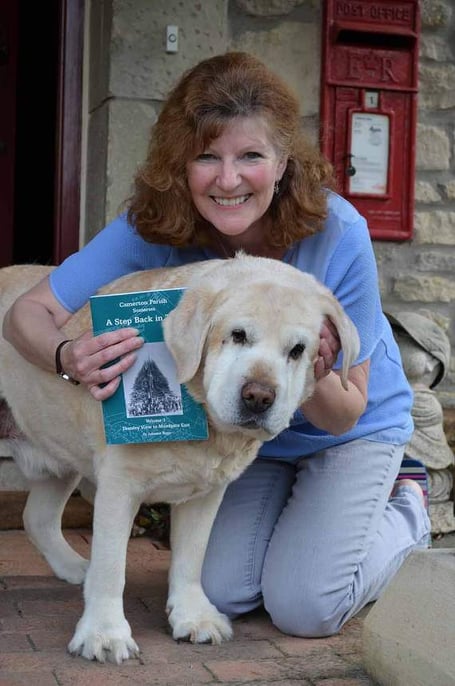
A blossoming interest in history over the past fourteen years has seen Camerton’s self-published author, Julieann Biggs, on a real adventure. Dealing with the highs and lows of life, Julieann found that writing and research was something she could come back to, time and time again, and the two pieces of work she has recently produced are testament to this, as she rediscovers the Camerton area in pin sharp detail in Camerton, A Brief History, and the first volume on the village: Camerton Parish Somerset,
A Step Back in Time – Densley View to Meadgate East. She is currently working on Volume Two, which will continue from Meadgate East to Meadgate West. This is due to be published later this year.
Originally from Keynsham, Julieann came to Camerton with her husband Nick and since developed a passion for the area. After being encouraged by her brother, Dave Gallop, to pick her book up again and continue with it, Julieann in turn, convinced Dave to return to his artwork. For a period of time they were able to help each other. The book slowly began to take shape and she was so pleased with her brother’s sketches, that she decided to put them in the book.
Julieann says: “It all began around fourteen years ago and turned from a hobby into something of an obsession! It feels like it has taken a lifetime to get this far. Because the information was spread all over the country and not in one place, it was important to me to try and keep all of the information I had managed to gather, together. Producing the book helped me to achieve that and seeing some of the work in print after such a long time has helped give me a sense of achievement and the hope people will enjoy the read.”
.jpeg?width=209&height=140&crop=209:145,smart&quality=75)

Julieann’s research has seen her travelling all over the country, taking her firmly out of her comfort zone, but also meaning that she has met some very interesting people with a tale to tell along the way. In 2012, she was curating the Camerton entry for the first in a series of exhibitions at Radstock Museum called ‘Down Our Way’ – village histories of Camerton, Paulton, Clutton and Shoscombe. She explains: “I have always
collected artefacts and local information, but this exhibition saw me knocking on doors in the village, asking for photos, objects, or anything people could contribute that would tell us more about the history of Camerton. Things started to come
together, and it was amazing what came out of the woodwork and the people that I met.
“It was probably the tattiest exhibition of the parishes, but it was ours, and it was real and rustic! It was hard work – but the most rewarding of all was when I saw how it brought people together. Local historian, Ken Taylor, was studying the Camerton exhibit, only to bump into a friend that he hadn’t seen for fifty years. It was amazing how far people travelled from out of the area who still had links to the locality.”
So inspired by meeting others with a love of local history, Julieann set up a History Group for Camerton, which first met in 2013 and still meets regularly today. They hold exhibitions at the Primary School (with the next being on the local railway) and enjoy day trips and informal meetings.
Publishing her work, which has been printed by Fosseway Press, in Radstock, has been a learning curve for Julieann and she says she has learnt lessons for the volumes to come.
From trudging around London with her backpack on “feeling like Paddington Bear”, to bravely approaching booksellers in Bath, Julieann has been supported by
independent booksellers, Harry Wainwright, from Oldfield Park bookshop, the
Titfield Thunderbolt in Larkhall and even No. 1 The Royal Crescent.
Her book has been described as ‘a labour of love’ and ‘a treasure trove of
memories’ by one reviewer, and this is very clear from looking through this painstakingly put together volume of local information. “I’m very passionate about Camerton,” says Julieann. “It is where my family and friends are – and there are families that are still here and have been here for over two hundred years.
“The book shows how changes in time slowly take place without us taking much notice, gradually forgetting what it was once like. The books describe the many various aspects of what a typical country village had and how it has slowly evolved to what it is like now. It is a sleepy village that you can drive through, blink and it is gone! But you never know what is down a twist of a lane that will lead you to a wealth of knowledge and a vast history that we can be very proud of.”
In her research for the book, Julieann has found a beautiful old map left on her doorstep, collected a list of funny names for farmers’ cows, been loaned a precious letter dated 1791, shown service medals, wonderful old family photos and incredible old documents.
Anyone who would like to buy a copy of the book can do so from Radstock Museum, Oldfield Park bookshop, the Titfield Thunderbolt or No. 1 The Royal Crescent. The booklet, which offers a more condensed version of the history of Camerton, can be bought from Camerton School, Radstock Museum and Timsbury Post Office, with profits from the booklet being donated to the local school.