
Jimmy Savile, who died recently, was the public face of a major 1980's advertising campaign for rail travel around the theme of 'This is the age of the train'. One of the main products on which this proposition was based was the then nearly-new Inter-City trains which linked the country at speeds of up to 125 miles per hour. Brunel's line through Bath to London was one of the major beneficiaries of that investment. With those trains now over thirty years old and many millions of miles run, they are still the workhorses of the Bath to London line until such time as the route is electrified. First, it was B&NES Council backing for a new station at Saltford and now Councillors want a new station for Bathampton. Lib-Dem politicians are keen to ease chronic congestion on the A4 London Road and the high levels of pollution which go with it.
The original station opened on 2nd February 1857. It closed to goods on 10th June 1963 and passengers on 3rd October 1966.
This new Bath Metro idea at Bathampton from the Bath Lib-Dem's perspective sees local park and rail, as successfully happens on the eastern side of
Edinburgh, eclipsing park and ride as the solution to traffic on London Road.



An expensive new roundabout would be needed on the Batheaston Bypass, with link roads taking cars to Bathampton Junction Station.
This low-lying area, with some flood risk, would be used for car parking, with much of it underground to placate the environmental lobby. This too would push up the price, making the planned Saltford Station seem cheap.
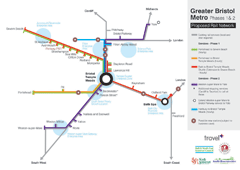
Trains servicing the station could include the infrequent Bath to Weymouth stopping trains and some Westbury-bound trains. Under the Greater Bristol Metro plans, hourly trains from Severn Beach are to be extended from Bristol to Bath, perhaps they could be extended to Bathampton or even Frome to provide more frequent links.
However, following the completion of rail electrification in 2016, the half-hourly London service could stop here and at Keynsham without risk of overcrowding, because most Bristol-London travellers would be travelling on the faster express trains via Bristol Parkway. This would create great new links to London for Keynsham and a well-connected Parkway Station at Bathampton Junction would reduce the number of people driving into Bath for London trains. The London trains would mean that the service into Bath and Bristol could be roughly every fifteen minutes, comparable with bus park and ride services.
The rub is that the car park would need to be huge to accommodate both types of users. Underground car parks are hugely more expensive than surface car parks, if these are unacceptable on environmental grounds.
Council officials have probably had the idea sprung on them. Just as well as it probably stops them dismissing it without thorough investigation.
The last Conservative administration to run B&NES planned extensive and expensive park and ride. The buses would still have had to go down London Road. The Lib-Dems axed the plans when they took over B&NES in May 2011.
The last scheme replaced a scheme going back to Avon County Council's days for a massive park and ride on Lambridge rugby training ground.
There is a real problem here. If it can be afforded, this could offer a real solution, but it wouldn't be park and ride as we know it.
The parking should not be free, but sensibly priced to help repay the heavy capital costs of constructing the station and underground car park. 2,000 cars at
£3 per day could produce revenue of £1.5 million p.a.!