

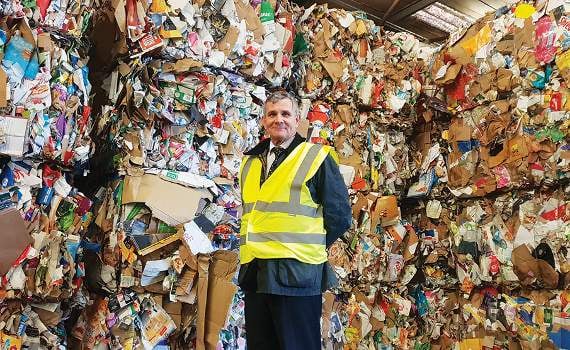
All Bath & North East Somerset Council wanted for Christmas was for residents to keep recycling.
Waste collectors are well and truly in ‘Amazon season’, the time of year when residents are getting presents delivered for loved ones.
Either side of Christmas Day, there is a flood of cardboard, glasses from parties, the dreaded wrapping paper and leftovers that are past their best.
All told, the volume of waste collected around Christmas can be a third more than in a typical week. With time off to spend with their families, the crews have to play catch-up well into January.




So, in the season of goodwill, B&NES Council is asking residents to play their part to keep things running smoothly – so it can maximise its income from their festive output.
Carol Maclellan, the authority’s group Manager for Environmental Services, said: “Over Christmas, one thing the public can do is separate their waste. That speeds us up – the biggest issue is sorting boxes.
“After Christmas, we see a lot more food waste. That’s where we’ve seen some of the biggest gains since the new fortnightly collections were introduced last November. There’s been an almost fifty per cent increase.
“Before, we had a collection every week for black waste. You could put out as many black sacks as you wanted. There was no incentive to recycle.
“Twelve months ago, we changed our whole service. You can put out as much recycling as you want. People realised they would have to start recycling.
“At Christmas, people produce more waste. The message about using your collections to the full is really important.”
As well as nearly fifty per cent more food waste since the service change last November, Council figures show crews collected nineteen per cent more recycling and thirty per cent less black bag waste.
Among the bugbears for waste crews are massive boxes for tiny products being delivered, bubble wrap that is destined for landfill, pointless cable ties and other packaging excesses like plastic bags around bananas.
Iain Buss, the Waste Facility’s Deputy Operations Manager, said: “From an operational point of view, foil wrapping paper is annoying, and glitter and bows. There’s nothing we can do with it.”
Use the scrunch test – if the material bounces back when it is squeezed, it is probably plastic.
Another frustration for collection crews is residents not lining their food waste bins, either with a plastic bag or newspaper, which can make emptying them disgusting.
The rotting meals and vegetable peels are driven to the anaerobic digester in Avonmouth, that uses the emitted gases to generate heat or power. Any plastic bags are ripped away, so it does not matter if they are compostable or not.
Waste collections may take a while, but it is an important job. The trucks are fitted with cameras to catch any residents who take out frustration on the crews.
Iain Buss added that one worker is pressing charges, after footage of an impatient driver trying to push him out of the way was passed to the police. Bouts of road rage are, apparently, a common occurrence.
The trucks also have tracking devices, so the Council can say for certain if the crews have visited a house, should the residents claim their bins have not been emptied. The crews walk dozens of miles every week, emptying hundreds of boxes each day.
Simon Porter, the Council’s Head of Waste and Fleet Operations, has had a go at the route himself and said: “People sometimes don’t realise what a physically demanding job it is. I would challenge anyone who thinks it’s easy – it certainly isn’t.”
Carol Maclellan added nowhere in the country collects more different materials than B&NES Council. It can get good money for selling them on, but they have to be as pure as possible. Every tonne of waste costs the Council £100, but it can sell the same weight of recycling for a similar sum.
The separation process is ingeniously simple. Cans and plastics come in mixed together. A magnet plucks off the steel, and an eddy current repels any non-ferrous metals to isolate the aluminium.
There is also a worker on a conveyor belt to remove any contaminants, like bags or black plastic, that cannot be recycled.
So, what does the future hold for recycling in Bath & North East Somerset? Carol said: “There’s a plan to consolidate into one new site. We’re shoehorned in here. It was never designed for the amount of waste we are taking. It’s quite congested.
“The plan is to have a brand new site in Keynsham, so we can modernise our operation for the benefit of all our residents.
“The real need is to move out of Midland Road (the recycling facility in Bath). This gives us the opportunity to be more efficient.”
Stephen Sumner, Local Democracy Reporter
Comments
This article has no comments yet. Be the first to leave a comment.