
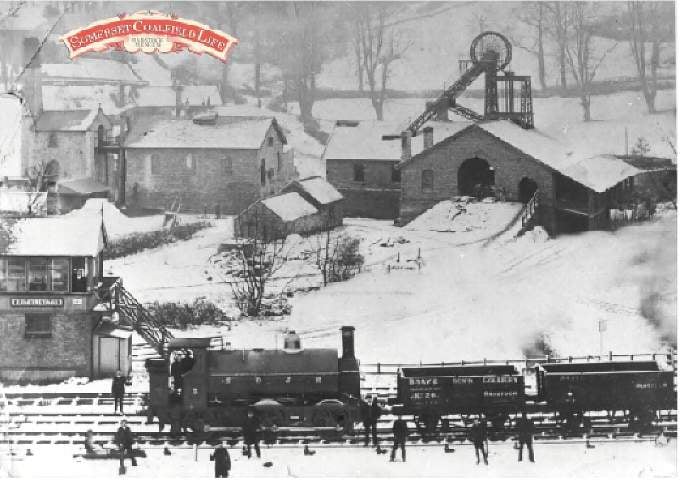
Did you guess last week’s Mystery Photograph? It was a little close to home last week – next door to The Journal office! Well done to Eric Brain and John Baker, who guessed correctly. It was Springfield Colliery, which is now the location of the Tesco superstore at Old Mills.
Thank you to Lucy Tudor, from Somerset Coalfield Life at Radstock Museum, who sent us this information.
She says: “The wooded batch behind the store is the former coal tip or batch.
“The shaft was ten feet in diameter, and 960 feet deep. The colliery buildings were constructed of locally quarried white lias stone and the chimney of brick.


“Springfield was linked underground to Old Mills Colliery, now the site of Wicks and Paulton House, next to which is the iconic conical ‘volcano’ coal tip or batch.
“The Springfield shaft was the downcast shaft, meaning the air used to ventilate the mine tunnels was drawn down this shaft – while the shaft at Old Mills Colliery was the upcast shaft, where the now circulated air came back up to the surface.
“Journal readers may be interested to know that both Springfield and Old Mills Collieries had steam powered winding engines built by William Evans Paulton Foundry in 1861 (Evans Foundry was at that time located at the bottom of Hanham Lane in Paulton; it is thought that the large stone wall with window openings located here still today is all that is left of the foundry).
“While Springfield’s winding engine was removed and replaced with an electric winding engine from South Wales, Old Mills, Evans’ built steam winding engine was in use until the colliery closed in 1966 and is believed to have been the oldest steam winding engine in use at the time of the pit’s closure being over 100 years old! The engine was dismantled and is stored on pallets in the Bristol Industrial
Museum (M Shed).
“In my opinion, it would be wonderful to bring this steam engine back to the area and work it using electric power as an annex to Radstock Museum – a site would need to be found perhaps at Old Mills to house the engine.
“The Brunel Shed in Radstock could house it and I understand some drawings exist to show the engine within the building, but it would be an enormous and costly project, it is more likely that the engine will eventually end up in a museum in the north of the UK.”
Eric Brain adds: “The Mystery picture is a bit close to home for you this week; just look out of your window across Wickes’ car park at the goods entrance to the rear of Tesco and the Old Mills Trading Estate!
“I remember Springfield Colliery well from cycling past on the coaldust-blackened road when the colliery was in its final years, or driving in my first car, a 1932 Austin Seven, under the narrow bridge carrying the spoil to the still-existing heap, on my way to Midsomer Norton.
“The pit was once owned by Evans of Evans’ Paulton Foundry and the cast-iron gate posts of the Springfield Pit can still be seen to your right in Thicket Mead as you sit at the traffic lights facing Midsomer Norton.”
A big thank you to Radstock Museum, who supplied this week’s photo. If you think you know where this week’s Mystery Photograph was taken and would like a mention, email: [email protected] before 5pm on Monday.
The Museum is now open 2 pm – 5 pm every day except for Mondays and 11 am –
5 pm on Saturdays.
Photographs of Springfield and all the other local collieries are in John Cornwell’s book, Collieries of Somerset & Bristol, available in the museum shop.
Comments
This article has no comments yet. Be the first to leave a comment.