
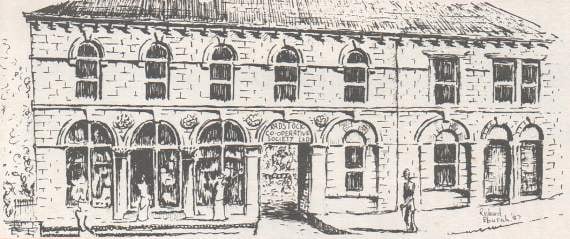
150 years ago, in early 1868, canvassers went from house to house in the mining town of Radstock, gathering subscriptions and membership of a proposed new Co-operative Society.


Enough money was raised for the society to purchase its first items to sell: butter, flour, oatmeal and candles.
The Co-operative movement was founded for the purpose of providing unadulterated food to working people who actually owned a share in the company and who could then benefit from a “divi” or dividend of the profits. For mining families this was an enormous help, with dividends affording them a special tin of biscuits at Christmas, or even new boots for one of the children.
At this time, the population of Radstock was 2,500, and growing rapidly. The new store opened on 1st July 1868 in the Pithay in Radstock, which was located in the area now at the back of Castello’s restaurant; the building no longer exists. By 1877, the Co-operative moved into a purpose-built store located at 3 Wells Hill; the building is still standing today and is home to Co-operative Funeral Care. Other village Co-ops established, all part of the Radstock Co-operative chain, and many of these still exist today. In 1959, the Radco Superstore was built.
Part of the 150th anniversary celebration sees a fascinating new exhibition at Radstock Museum, which will be on display from Tuesday, 1st May until Friday, 31st August. Illustrated by memories of staff and customers, past and present, the displays explain the breadth of the Radstock Co-operative Society’s business, including farms, dairies and bakeries, its delivery service and advertising and its role in the community over the last 150 years.
Some of the calendars produced in the 1980s and 1990s included artwork by renowned local artist, the late David Fisher. David’s beautiful, original drawings will be on display. A new book detailing the Society’s history will also be available from mid-May.
Comments
This article has no comments yet. Be the first to leave a comment.