

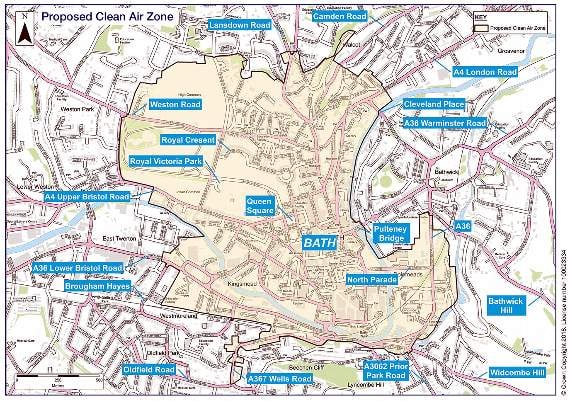
With concern over the reliability of statistical modelling, and the prospect of putting in place mitigating measures, it seems it is no longer a foregone conclusion that the Clean Air Zone charging will have to include cars. B&NES Cabinet met last week and defended the decision to delay the proposals, whilst the consultation response, the biggest ever for the local authority (around 8,400), will be scrutinised in further detail.
The Council had been given a decision deadline of 31st December by the Government, and may be fined for missing this deadline. But Councillors argued that listening to those who had taken the time to respond and evaluating their comments was more important.
This news may come as a breath of fresh air for the thousands of residents of North East Somerset who regularly commute into Bath or travel north to a motorway, as the consultation, which launched in October, seemed to imply that a £9 per 24 hour charge was a done deal.
Putting the brakes on this decision seems to stem from three factors. Firstly, the Cabinet seems to be questioning the statistical modelling by officers and consultants which had been driving them to introduce the proposed measures.



Secondly, the massive response from the public has undoubtedly helped delay the Cabinet from being forced into a making a decision, which some of the opposition were calling for. With 8,400 responses to analyse, the officers will now need more time to process what has been said. What is staggering is that Bath and North East Somerset, with a population of almost 185,000 residents, received around the same level of responses as Birmingham – which has a population of just over 1 million. In all, more than 1.7 million words were submitted, and some responses were up to 64 pages long.
Thirdly, Cabinet members reiterated that it was essential not to lose sight of the original DEFRA advice, which was to achieve the clean air targets as soon as possible, but not at any cost. In other words, measures should be proportionate, by considering the impact on residents and the local economy.
The starting point for the Clean Air Zone was prompted by the Government losing a legal battle against Client Earth, which meant that it issued a requirement to Local Councils, identified with high levels of pollution, to comply by 2021 with a level of clean air, reducing harmful levels of nitrogen dioxide. As the work progressed, the assumption was that any measures would be directed at larger polluting commercial vehicles and buses.
However, in early Autumn, B&NES’ officers and consultants pronounced that their modelling work clearly showed that cars had to be included in the CAZ. It was this belated twist that resulted in the impression that charging cars was a foregone conclusion.
However, as more details of the highly technical assumptions which underpin the predictive model have been revealed, the Cabinet and members of the public have increasingly begun to challenge the experts on the basis that they have assigned to it a level of predictability far beyond what is reasonable and safe. In a nut shell, it could be argued that there is little difference between including and not including cars (options C and D).
Such is the strength of feeling on this, that local B&NES Cllr and Cabinet Member, Paul Myers, spoke out strongly at the recent Cabinet Meeting. He said: “It leads me to publicly question that any assumption that this Cabinet can only realistically consider Option D is not correct. If you remember nothing else from what I am saying today – I hope it will be that as far as I’m concerned, charging cars is not a foregone conclusion.
“I particularly welcome the time we now have to properly review the thinking, and I support a two-stage sequential test, where under Step 1: On the basis that the model and statistics can be checked and verified, we establish what proportionate measures will achieve the level of clean air to protect public health.
“Then we ask the question, Step 2: Are the proposals proportionate in terms of creating a situation where people’s livelihoods are not destroyed, along with our local economy – and are there mitigations and ameliorations, which I believe could temper it?
“It really saddens and bewilders me to hear people criticising us for taking the time to listen to our residents. The policy we come up with should be done in a way that doesn’t unfairly penalise ordinary working families.”
Whilst Cllr Myers argued that “this is not just a Bath issue”, Cllr Karen Warrington, (Conservative, Clutton), Cabinet member for Transformation and Customer Services, added: “We know we have issues in North East Somerset as well, but they are not part of this Government directive. I am hoping that once this directive is solved, it will have a knock-on effect instead.”
Council leaders denied ‘side-stepping’ the debate or ‘kicking the can down the road’ to put off the decision before the local elections in 2019. Council Leader, Tim Warren, said he hoped his administration could give “a direction of travel” which could be taken forward by whichever party is in power. It is likely there will need to be a special Cabinet meeting before purdah (18th March to 3rd May 2019); the pre-election period that restricts publicity.
Councillor Bob Goodman, Cabinet member for Communities and Neighbourhoods, told the meeting that the process could take another six to eight weeks whilst the consultation is analysed. He also warned Councillors that should this decision be rushed, it would likely open the Council up to a judicial review.
Leader of the Council, Tim Warren, closed the debate by saying: “We do have to work together. Whilst this [the consultation] has given us an awful lot of work to do, it has also given us a lot of ideas.
“This is bigger than any of us, and we need to do it properly. Providing people on low incomes with interest-free loans to buy new cars is all very well, but if they can’t pay it back, what’s the good in that? And if people cannot get to work anymore, then that is also a serious problem.
“If we rush into this and get it wrong, we have got a lifetime to regret it. We owe it to everybody to give it a full response.”
Comments
This article has no comments yet. Be the first to leave a comment.