

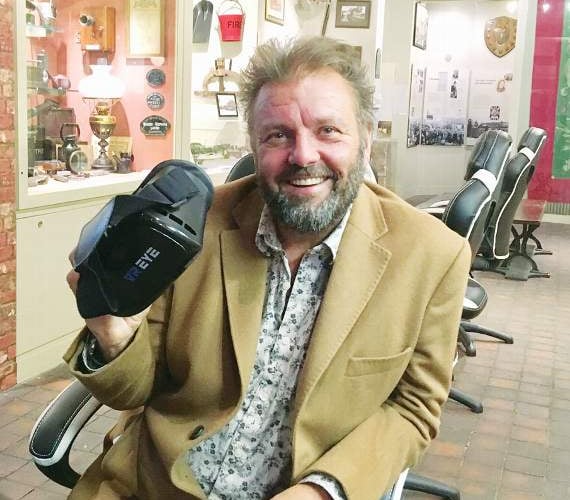
Paulton’s BBC1 Homes Under The Hammer presenter, Martin Roberts, visited Somerset Coalfield Life at Radstock Museum last week to find out more about the new Virtual Reality Coal Mine and was also given a guided tour of the museum by volunteer, Lucy Tudor and Museum Development Coordinator, Miranda Litchfield.
Apart from thoroughly enjoying the VR ride, which he tweeted to thousands of followers, Martin was really interested in everything the museum has to offer.
Martin wondered how the museum had gathered all the artefacts inside, and was told about the original team who collected much of what is on display today and that the process is constant; with people donating items all the time, which have to go through the acquisitions and documentation team to be catalogued and safely stored in special conditions to preserve them.
Artefacts then sometimes go on permanent display, during exhibitions or are viewed by individuals who come to carry out research projects.



Living locally, Martin has a particular interest in the Paulton Collieries and was keen to see a photo of Old Mills Colliery and understand exactly where it used to be. Martin also enjoys walking by the Somerset Coal Canal in Paulton and asked where the canal took the coal produced locally, passing through villages such as Camerton, Combe Hay and Midford and on to join the Kennet and Avon Canal. He was delighted to hear that the entire length of this old canal is gradually being restored by the Somerset Coal Canal Society.
He was also surprised to learn that there was an iron foundry in Paulton by the name of Evans, and amazed that the foundry repaired the canal boats, which ran from Paulton, and had made the winding engine for Old Mills Colliery – he was even more interested in the fact that the winding engine still exists – complete, but currently dismantled and in storage in Bristol. He said he would look out for the lovely old gateposts and railings in Hanham Lane, Paulton next time he walks that way, as these too were made at the foundry.
Martin was particularly struck by the fact that in early Victorian times, boys as young as five-years-old would start work in the coal mines as trap boys, he was introduced to the museum’s trap boy mannequin ‘Gus’ and listened in horror that boys like Gus would sit down in the mines for eight hours a day, often in complete darkness as a candle was too expensive, opening and closing doors in the main roadways underground to create a through draught to prevent build-up of poisonous gasses.
Martin said: “I will be returning to the museum with my children, as they need to know how lucky they are to be living today and not have to work down the pit!”
He also enjoyed looking around the old Victorian schoolroom and handling the cane, recalling it was still in use when he was at school. He was intrigued by the finger stocks, whereby children would put their fingers through holes in shaped pieces of wood and have their hands tied behind their backs to prevent fidgeting, or if they were left-handed have their left hand put into the finger stocks and tied to the bench so that they had no choice but to use their right hand. This practice has links going back as far as medieval times, when left-handed people were thought to be consorting with the devil or witchcraft!
Martin was also fascinated by the Railways, which crisscrossed the area in days gone by; he particularly enjoyed studying the model railway exhibit showing the Somerset and Dorset and GWR railways in Radstock.
All the volunteers at Somerset Coalfield Life at Radstock Museum would like to thank Martin for taking the time to visit and use his celebrity status to help promote and publicise the museum. He said: “The museum has packed a great deal into the building, and it is really excellent.”
Comments
This article has no comments yet. Be the first to leave a comment.