

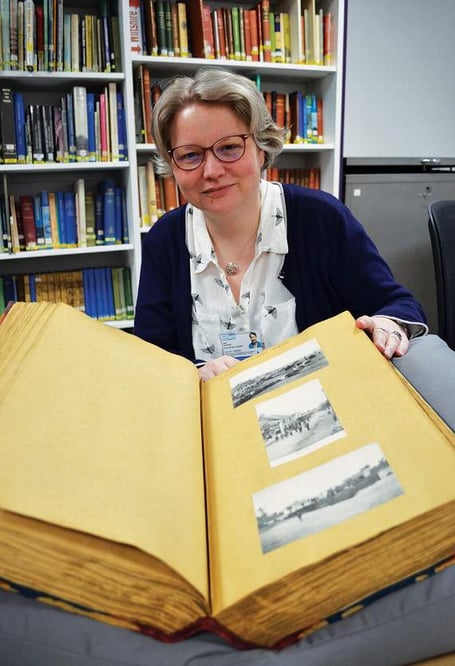
A treasure-trove of old photographs depicting scenes from Midsomer Norton, Chilcompton, Camerton, Kilmersdon, Hallatrow and many more have been uncovered by Local Studies Librarian, Anne Buchanan, at the Bath Record Office, contained within the basement of the Guildhall.
Pictured is just one of 36 volumes of postcard scrapbooks compiled by Richard W. Boodle, who was a former public librarian in Birmingham. He had spent part of his life in Canada, before returning to the UK, and sadly died in a tram accident on 17th November 1918, aged 70; with his belongings then passing to his younger brother, Charles E. Boodle, who was born in Chilcompton. Their father, Robert Boodle, was a local doctor.
The scrapbook was donated by Charles in 1919 and the postcards, it is thought, would have been bought for around a penny each, which, whilst not extravagant at the time, was not cheap, either. Collectively, it would have been quite an expensive hobby!
Back then, photographers used to make a little bit of money by selling images for postcards, and it was a popular form of communicating with loved ones on a regular basis.



We’ll be printing some of the images found over the coming weeks in The Journal, and would love to hear your thoughts and memories, but readers can also view them at the Bath Record Office, who collect and keep safe historic records from the area, and offer help and advice on family, local and other historical queries. Many people use the facility for family research, but it also houses a wealth of information and collections.
Anne says: “Sadly scrapbooks are a dying art – but we keep many here in the archives, including cuttings of newspapers, such as The Journal – they are a fantastic resource for finding out what was happening at the time, and what people’s views were on current issues.
“Over the years, we’ve seen a change in storage formats; for example, we have lots of CD-roms, casette tapes, VHS, and more – I have tradecards (business cards) that date back to 1725, and Theatre Royal playbills that go back to the 1770s. They all provide valuable information about life at that particular moment in time.
“With everything converting to digital, we are in danger of losing our current period of history and all of these precious records; people do not write letters anymore, everything is lost in emails and text messages. But at the same time, we are seeing a revival in print, for example, the Harry Potter books have just been reprinted beautifully to celebrate their 20th anniversary. Rather than mass marketed paperbacks, print is now crafted and increasingly valued.
“We try very hard to keep printed records and welcome any local history books that people may have self-published. It’s wonderful to have one to keep for reference, and many residents often donate one or two.”
Also in the archives are the local newspapers, with the first paper in the area recorded as the Bath Journal, which emerged in 1744. The Bath Chronicle came to life around 1760 and in the 1860s, The Somerset Guardian was first published.
Anne says: “It is fascinating going back through the news stories; one thing for certain is that human nature doesn’t change – we still seem to get in the same scrapes, it’s just the circumstances and surroundings that vary!”
The Bath Record Office is open Tuesday through to Friday from 9 a.m. – 1 p.m., closing for an hour and then reopening from 2 p.m. – 5 p.m., but closing earlier on Fridays at 4.30 p.m. They provide free access to the Ancestry, Find My Past and British Newspaper Archive websites and its own online database, called Bath Ancestors, with over 75,000 names on file.
Look out for the first photograph in next week’s paper, and on our Facebook page.
We’ll be printing some of the images found over the coming weeks in The Journal, and would love to hear your thoughts and memories, but readers can also view them at the Bath Record Office, who collect and keep safe historic records from the area, and offer help and advice on family, local and other historical queries. Many people use the facility for family research, but it also houses a wealth of information and collections.
Anne says: “Sadly scrapbooks are a dying art – but we keep many here in the archives, including cuttings of newspapers, such as The Journal – they are a fantastic resource for finding out what was happening at the time, and what people’s views were on current issues.
“Over the years, we’ve seen a change in storage formats; for example, we have lots of CD-roms, casette tapes, VHS, and more – I have tradecards (business cards) that date back to 1725, and Theatre Royal playbills that go back to the 1770s. They all provide valuable information about life at that particular moment in time.
“With everything converting to digital, we are in danger of losing our current period of history and all of these precious records; people do not write letters anymore, everything is lost in emails and text messages. But at the same time, we are seeing a revival in print, for example, the Harry Potter books have just been reprinted beautifully to celebrate their 20th anniversary. Rather than mass marketed paperbacks, print is now crafted and increasingly valued.
“We try very hard to keep printed records and welcome any local history books that people may have self-published. It’s wonderful to have one to keep for reference, and many residents often donate one or two.”
Also in the archives are the local newspapers, with the first paper in the area recorded as the Bath Journal, which emerged in 1744.
The Bath Chronicle came to life around 1760 and in the 1860s, The Somerset Guardian was first published.
Anne says: “It is fascinating going back through the news stories; one thing for certain is that human nature doesn’t change – we still seem to get in the same scrapes, it’s just the circumstances and surroundings that vary!”
The Bath Record Office is open Tuesday through to Friday from 9 a.m. – 1 p.m., closing for an hour and then reopening from 2 p.m. – 5 p.m., but closing earlier on Fridays at 4.30 p.m. They provide free access to the Ancestry, Find My Past and British Newspaper Archive websites and its own online database, called Bath Ancestors, with over 75,000 names on file.
Look out for the first photograph in next week’s paper, and on our Facebook page.
Comments
This article has no comments yet. Be the first to leave a comment.