
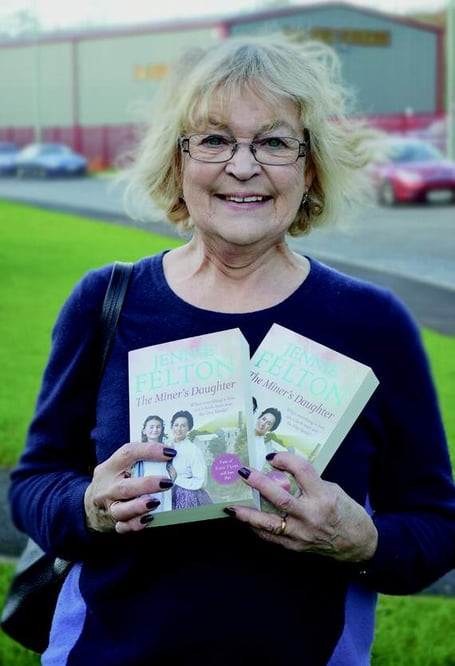
Well-known local author, Janet Tanner, is now seeing the paperback version of The Miner’s Daughter, in print, her second full novel in‘The Families of Fairley Terrace Sagas’, having just finished the third and signing a contract for a further three books!
The hardback version of The Miner’s Daughter was published last autumn and the prolific writer says she has written around forty books but isn’t exactly sure how many – most recently with the pen names, Amelia Carr, (four novels) and Jennie Felton, (current series, three novels) and many, of course, as herself.
The most recent sagas, with the first being All the Dark Secrets, takes inspiration from the local mining tragedy in 1895, when twelve men and boys were killed at Wellsway pit in Westfield. It is thought the rope the miners were using to descend into the pit was maliciously cut. Nobody was ever caught for the act, for which a monument stands in St John’s Churchyard, Midsomer Norton.
Like the novel before it, The Miner’s Daughter continues the story of a different family in Fairley Terrace, who again have their lives turned upside down by the same tragic event. When Lucy and her sister Kitty have to go and live with Algernon, the new husband of their recently widowed mother, who accepts his offer solely to keep the family out of the workhouse, they find life becomes even harder and


crueller than they expected.
After a horrific event, Lucy is forced to leave behind her family and a blossoming
romance, fleeing to London and on to the music hall stage in the footsteps of her aunt. Here, she meets Jake, a bare knuckle boxer who may or may not be the illegitimate son of her aunt, but leads her to a dangerous and desperate
situation in a tense finale, whilst her family falls apart at home. Forced into a corner, one of the family members makes a decision that could change all of their lives forever.
“It took me a year to write the book,” explains Janet. “For my longer novels, this is the norm, and I was writing to a deadline.
“The novel covers some difficult subjects, but it is good to have something really
powerful to get to grips with. I do research everything very thoroughly, even down to looking up the weather reports of that time. I don’t suppose anyone would know if I had a snowy winter when it was actually wet and foggy, but it helps me to think myself into the story if I can visualise it accurately. Researching bare knuckle fighting and the Music Hall was also very interesting and enjoyable!
“I begin with a rough synopsis of the story, mainly just the beginning and the end, the background and some of the major incidents along the way. How it then develops emerges as I write. One of the most daunting things is getting to about 60,000 words and realising I still have the same amount to go! I try to balance the story with light and shade and ‘keep all the balls in the air’ with the various threads and characters.
“I have just delivered the third in the Families of Fairley Terrace series, which is to be called The Fairley Maid, and tells the story of Edie (Lucy’s childhood friend), who is employed at Fairley Hall, home of mine owner, Sir Montague Fairley and his sister, Lady Elizabeth. On the Christmas Eve following the pit disaster, a baby was found abandoned in the porch of the Catholic Church by parishioners arriving for midnight mass. She was adopted by Lady Elizabeth and now she asks Edie, who is her lady’s maid, if she can help her discover who her real mother is. This book will be out in hardback next October and the paperback will follow, probably once again, in the
following January.
“Do I still enjoy writing after all of this time? I think the simple answer is that I don’t think I could live without it!”
The Miner’s Daughter can be found in Tesco, Asda, Sainsbury’s and W.H. Smith stores and is also available as an e-book.
Back in September last year, Janet was contacted by an Australian reader, who stumbled upon her work after doing some research into her family tree. It turns out she is a descendant of William Summers, one of the young miners killed at Wellsway. The reader says: ‘His life ended tragically, but the events ensured that his many, many descendants now live happy and productive lives here in Australia.’
William had been married to his wife, Elizabeth, for only a year with a baby daughter, the reader’s great, great, great grandmother. The baby was given to Elizabeth’s sister, who set sail for a new life in Australia. However, both Elizabeth and her sister had a convict father who had been transported to the country for life after stealing a cow, which may have been why the family made the decision to move.
Elizabeth did join her sister and daughter a year later, along with their younger brother. She married a man she met on the ship and had another child, however, when the baby is only two months old, Elizabeth dies of dysentery. The daughter, like her half sister, was taken in by her aunt and uncle, who in turn grew up to be a ‘pillar in the community’, bringing up thirteen children of her own and helping to build both churches and schools in Victoria, Australia.
The reader signs off: ‘I just thought that you may be interested in a real story
related to what you have written!’