
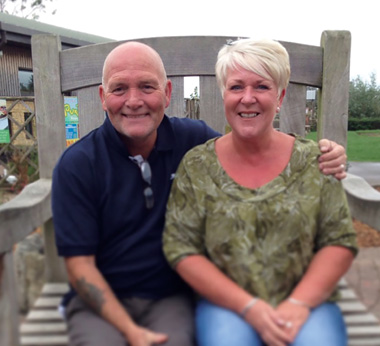
"I remember Paul would come home from his job in construction and say that some of the young guys at work were hiding his tools. At the time, I didn't think much of it, but now I realise it was the start of his memory problems."
Tracey Seymour's husband, Paul, was just 54 when he was diagnosed with early-onset Alzheimer's disease.
"A few things started to happen at home – Paul would leave the fridge door open, forget his keys, or couldn't remember what I'd asked him to get at the shop – and the penny dropped for me that something wasn't right," says Tracey, from Midsomer Norton.
After a visit to his GP, Paul was referred to the RICE Memory Clinic.




"When we walked in, there was a lot of information about dementia and I thought, this is it. I knew why we were there. All theinformation, the posters, though, were all directed at the elderly. Paul noticed this and he just looked at me and burst into tears. I knew then he was frightened, I knew that this was the path we were going to go down.
"The consultant was upset when she delivered the news. She said we were very young to be seeing her, which made it hard for her to say that it was Alzheimer's."
The couple, who have been happily married for 32 years, initially had difficulty accepting the news.
"We had a fortnight or so of shock, disbelief and 'why me?' But then we decided that these are the cards we've been dealt, so let's get on with it. Part of that, for me, is getting the word out there that it can happen in your fifties. There might be a lot of people that age feeling 'forgetful' and not getting the support they need, because they just don't think it could ever be dementia or Alzheimer's," Tracey says.
Tracey said originally when she was offered support as a carer she felt like a fraud. "I didn't think I was a carer and I do feel it is my duty as his wife to look after Paul, as he has looked after me through the years. But I do realise how important that support is and I'm lucky to be in an area where there is so much support.
"And I do know now that I'm doing more than I would – Paul needs a routine and I play a big role in managing that, plus running the household and working part-time.
"Paul is still working, which is wonderful and everyone at work is supportive and understanding. But I do think of the future, when he won't be able to continue and I wonder about what life will be like and how the financial situation will be."
Ultimately for Tracey, it's important to find the balance between living life normally and accepting that Paul has Alzheimer's.
"We do make jokes," Tracey says. "When Paul has a mishap, my son might say, 'Honestly, dad!' and Paul will say, 'Well I'm allowed, I have Alzheimer's!' I think it's helpful for Paul to have some sense of normality and openness.
"5% of all Alzheimer's cases are classed as early-onset, which is defined as 'under 65'.
"It's not a lot – but we are in that 5% and I think people just don't see us. I want to take this and help people understand that it's not just old people who can get Alzheimer's. I would love to see a picture at theMemory Clinic of someone younger, someone who is still working, someone with a mortgage and children. Because that is the reality."
This week is Dementia Awareness Week. If you think you might be a carer, you can get support at the Bath and North East Somerset Carers' Centre. Call: 0800 0388 885 or visit: http://www.banescarerscentre.org.uk">www.banescarerscentre.org.uk