
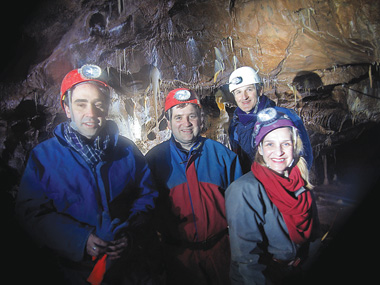
In early December, local resident and caver, Mark Lumley, invited candidates from all political parties on a brief tour of the Mendip Hills and Somerset Coalfield, visiting stream sinks, resurgences and mines of PEDL 227, in particular, the East Mendip region, believed to be the source of the water for Bath's Hot Springs.
The intention was to ensure that candidates were aware of issues particular to the cavernous, fractured geology of the Mendip plateau and Somerset Coalfield. In particular, the possible dangers to our reservoirs and water supply if drilling were to take place amid the area's countless underground streams. The hydrological link between this area and Bath Hot Springs was discussed at length, together with worries about methane leakage to communities above old mine workings if the Government were to override concerns raised by Mendip and B&NES Councils and give the green light to fracking or drilling for coalbed methane in this fractured, cavernous, heavily mined area.
Previously, Mr Lumley, an advisor to Somerset County Council's East Mendip Strategic Groundwater Study and a cave explorer for over 45 years, took Wells Constituency Conservative Candidate, James Heappey, down Swildon's Hole, at Priddy. Wells' Tessa Munt MP (Liberal Democrat) has been caving before and is aware of the issues. A trip is planned shortly for Chris Inchley, the Wells Labour Candidate.
Todd Foreman, the Labour NE Somerset Candidate, Wera Hobhouse, Liberal Democrat NE Somerset, and Dr Gordon Ingram, Green Party NE Somerset, accepted the invitation and took their place on December 5th.




The visit was a great success with all three candidates finding the trip constructive, leaving them with a clearer understanding of the relationship between the Mendip Hills and the surrounding area.
Liberal Democrat Candidate, Wera Hobhouse, said: "I am a strong supporter of renewables and an opponent of fracking because it is a fossil fuel. But until the caving expedition, I hadn't understood the complex geology of the Mendips. Nor had I realised the big gaps in our understanding of how water reaches the Hot Springs in Bath. Seeing the way water flows through the rocks underground and the way nature has twisted and contorted the geological strata, I cannot believe that any fracking company is going to be able to predict how drilling will affect our water supply."
It was a sentiment shared by the other candidates, with Dr Gordon Ingram commenting:?"It seems ridiculous that the licence has been granted at all." Todd Foreman, the Labour Candidate, said:?"It has just reinforced that here is not the appropriate place for fracking."
Unlike his fellow candidates, Jacob Rees-Mogg MP (NE Somerset) declined the invitation. In his response to Gas Field Free Mendip, who helped to organise the trip, the MP declared that he was "Aware of the work of William Smith". William 'Strata' Smith was a geologist who lived from 1769 to 1839, working on the Somerset Coal Canal, as well as part of the Somerset Coalfield. In 1799, Smith produced the first geologic map of the area around Bath.
Alongside his work on the coalfield, William Smith was the expert called in by City of Bath officials in 1810 to investigate the failure of part of the Hot Springs complex. Although it proved not to be the main contributory factor, Smith was successfully able to demonstrate that pumping operations at trial coal shafts more than 4km away at Bathampton were having a significant detrimental effect on the refill rate of the famous baths. The situation only returned to normal when mining operations ceased, c.1813.
This discovery, reinforced by a similar unfortunate event involving a brewery well some twenty years later, has uncomfortable parallels to current concerns raised by B&NES and others about the impacts of drilling for coalbed methane above the catchment for Bath Hot Springs, which are estimated to bring £12.3m p.a. to the local economy. Mr Lumley was disappointed by Jacob Ress-Mogg's absence, stating that the invitation, accepted by other invitees from parties of many colours, was a well-intended, non-party-political attempt to ensure that candidates were well informed on these crucial, local issues.
Local geologists have also been urging our politicians to discuss these local issues far more thoroughly before any decision is taken on drilling. UK Methane have renewed their licence for PEDL 227 (Petroleum Exploration and Development Licence) which runs from Clutton and Timsbury in the North, close to Shepton Mallet, and Downhead in the South. An application for an 800 metre borehole and over 20 kilometres of seismic surveys in the area is anticipated.