

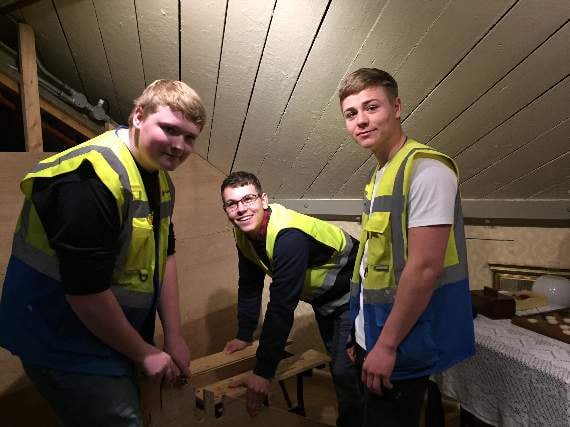
Students from Bath College in Radstock are constructing the walls of James McMurtrie’s parlour, a new permanent display in Radstock Museum.
James’ real parlour was in his home: South Hill House, a nine bedroom property now
demolished, previously sited on the grounds where Bath College’s Somer Valley campus stands today. So, the museum is delighted that students from Bath College have been the ones helping to reconstruct his parlour at the museum.
So, who was James Mc-Murtrie? Well, he was born in Ayrshire in 1840, later becoming a mining engineer in the Newcastle area. Meanwhile, Newbury Colliery Company in Coleford had two mines operating at this time and looked to the north for engineering ideas which could make their mines more profitable and safe.
.png?width=209&height=140&crop=209:145,smart&quality=75)
.jpeg?width=209&height=140&crop=209:145,smart&quality=75)

James McMurtrie was interviewed for the position of Manager at Newbury Colliery and got the job. He made many improvements – most notably, he joined the two coal mines together underground; at one mineshaft, he had a chimney and a furnace built. The fire drew air up from the mine tunnels and tunnel underground, pulling air down the shaft of the second mine and so creating an underground ventilation system. This and other improvements saw profits soar.
These profits came to the attention of Countess Waldegrave and her husband at the time, George Harcourt. Countess Waldegrave (who had inherited the entire Waldegrave estates in Somerset, Essex and London, on the death of her second husband, George
Edward, the 7th Earl Waldegrave, in 1846), owned all the mines in Radstock at this time. She offered James McMurtrie double the salary and other benefits to work as Under Manager at Middle Pit in Radstock. He took the job, with his challenge to make and send to their London bank £2,000 quarterly – James sent £4,700!
George Harcourt and Countess Waldegrave asked James to manage the agricultural business on their estate, which he did and also made a success of. George died, and the Countess married Chichester Fortescue. The couple asked James to find a suitable property in Somerset for their country residence. McMurtrie found the Old Priory at Chewton Mendip and in the 1860s, had builders restore it.
To thank James for all of the work he had done over the years, the Countess paid for the house at South Hill Park (now Bath College) to be built for James and his enormous family. Through bereavement, he married three times and had seventeen children.
James worked for Countess Waldegrave until she died in 1879. She died in London, but wanted to be brought back to be buried at the church of St Mary Magdalene in Chewton Mendip. He continued to work for the Waldegrave Estate and Coal Mines until 1905 when his eldest son, George, and his second son, Hugh, took over. They ran the mines until the 1920s, when they were sold to the local Beauchamp family.
James retired to Bristol where he died in 1914 at the age of 74. He was an exceptional engineer and geologist, and wrote and presented many papers on coalmine engineering and the geology of the Somerset Coalfield to local societies
during his lifetime. He was also keen on archaeology and made studies of the local Roman road, the Fosseway. The museum holds these papers, drawings and diagrams.
The Waldegrave estate today includes 3,000 acres, mostly on the Mendip Hills, as well as a few buildings in the former mining town of Radstock, including the building which houses Castello’s restaurant and the former St Nicholas
Infant School.
The estate has belonged to the family for many generations. It was given to Sir
Edward Waldegrave in 1553, by Queen Mary. It still belongs to Sir Edward’s direct descendants, the present 13th Earl Waldegrave and his sons.
The main house on the estate was used as a barracks during World War II, but it was so damaged, that it was pulled down. South Hill House was also used as a barracks, after which it was flats for a time – it was demolished in the 1950s and Radstock Technical College was built.
Lucy Tudor