.jpg?width=94&height=94&crop=1:1,smart&quality=75)

“To the memory of Heroes.” This was the headline in The Somerset Guardian on Friday, 12th November 1920. One hundred years ago, on 11th November in the afternoon the cenotaph in the High Street, Midsomer Norton, was unveiled and dedicated on a strip of land outside the War Memorial Hall (more popularly known as Bob’s Palais). Exactly two years after the guns fell silent at the end of the Great War – the war to end all wars – or so they said at the time.
The cenotaph is an exact replica of the one in London which had been unveiled by the King in the morning of the same day. Sir Edward Luteyns willingly gave permission for the use of the copyright of his design to be used in the town. The memorial at Midsomer Norton is “composed of St Aldhelm (Box) stone on a three tier base of blue Kynton stone. The wreath is in cast bronze work, with side ribbons and dropper”.
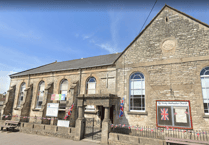
The idea of a memorial was that of Captain J.S. Thatcher, the son of Mr John Thatcher of the Hollies. Captain Thatcher, who was severely wounded in the war, bore half the cost whilst ex-servicemen found the balance. At 2.30 pm in the afternoon of the 11th November 1920, ex-servicemen formed up in the Market Square (The Island) and processed to the site in front of the War Memorial Institute.
There was a “tremendous gathering” at the ceremony which was performed by the Rev. J.R. Davey, who was accompanied by Rev. P. Hawkes, Wesleyan minster and the officer in charge of the local Salvation Army Corps. Leading members of the Urban Council, Mr J Thatcher, J.P. and many prominent residents were also present.

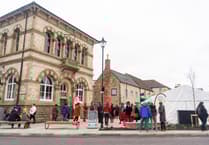

After the prayers of dedication Rev. Davey drew aside the Union flag which covered the cenotaph and delivered an address. At its conclusion, the Midsomer Norton Town Band played the Death March, The Rev. Peter Hawkes read a passage of scripture and offered prayers and the “Last Post” was sounded by a bugle party from Bath. Mr Fred Gould, J.P. made a few remarks concerning the sacrifice of those who had laid down their lives and the suffering of those who had returned with terrible wounds, both mental and physical.
Afterwards, the buglers sounded the Long Reveille and this concluded the ceremony. A large number of wreaths and a large cross was then laid at the foot of the cenotaph or hung on the railings surrounding the monument.
Colonel Sir Frank Beauchamp had been invited to unveil the memorial but was unable to do so due to “urgent business in London”. The Bishop of Bath and Wells had also been invited to dedicate the memorial but due to prior arrangements, declined the invitation. He had suggested another date, but arrangements were too advanced to amend it.
As with the cenotaph in London, there were no names inscribed or plaque attached giving names of the fallen as these were to be on two bronze plaques in the main entrance of the Memorial Hall.
On 3rd June 1932, a special general meeting of the British Legion met to consider the repositioning of the Cenotaph on a bridge across the stream, a site approved by the Urban District Council. As the “stone” was a memorial funded by ex-Servicemen, it was necessary to obtain their approval. The proposal was passed by all present except one.
The financial situation was the discussed with a cost of between £70 and £80 – it was left to the general committee to arrange ways and means to find the funds. In the end, it was decided to open a subscription list. The removal work was completed by Armistice Day, five months later.
The 1932 Remembrance Parade formed up at London House, Welton and marched via the High St. to the parish church for a service at which many were standing, as all seating was full.
At the conclusion of the service the parade still led by the Town Prize Band followed by the Silver Band, Territorials, ex-Service men, British Legion, Scouts and Guides plus members of the Council.
At the Cenotaph, a number of wreaths were laid after the vicar had rededicated the memorial in its new position. In conclusion, the “Last Post” was sounded by Bugler Salmon and the bands played the National Anthem.
At the Remembrance Sunday service in 1946, the President, Major Thatcher, told the crowd at the service at the cenotaph that it had been decided to have two plaques for the fallen – one for each conflict.
But it was not until 23rd April 1948 did a news item appear which explained the two plaques would cost £150. To defray the costs, there was a house to house collection made in the first week of May by the British Legion members.
On Remembrance Sunday that same year, Rear Admiral Butler of Ston Easton, who lost two sons in the war unveiled the plaques.
A parade formed up at the football field in North Road and marched to the church for a service conducted by the vicar. Afterwards, the parade reformed and marched to the cenotaph where the Methodist minister, Rev. W. J.Beckett, took the service.
The plaques bearing the names of those who fell in both wars are affixed to the eastern and western sides of the memorial. The plaques were the work of Mr. F Humphreys of the town to the design of Mr. H Cox. After a short speech by Rear Admiral Butler, the dedication was undertaken by the vicar, Rev. C Scott. The ceremony was concluded by the laying of wreaths. Last Post and Reveille were then sounded, the names of the fallen read out, the Legion poem read and finally the National Anthem was played. The parade then re-formed, marched down the southern side of the river, crossed over the lower bridge and back up the High Street where Rear Admiral Butler took the salute at the cenotaph.
The inscription reads: “In grateful memory of those who gave their lives in the Two Great Wars 1914-1918 1939-1945 They shall not grow old”, 1914-1918 (names). The wording on the opposite face is the same, listing the remainder of the 1914-1918 war and those for the 1939-1945 conflict. One end is blank whilst the other at the top are the Roman numeral MCMXIX, under which is a bronze wreath. This followed by the words, “The Glorious Dead”.
Finally, there is a bronze plaque reading: “Erected by ex-officers, NCOS and men of Midsomer Norton in memory of their comrades who fell in the Great War 1914-1918”. Quite why the roman numerals showing 1919 are displayed is not understood.
David Carter
Comments
This article has no comments yet. Be the first to leave a comment.