.jpg?width=94&height=94&crop=1:1,smart&quality=75)

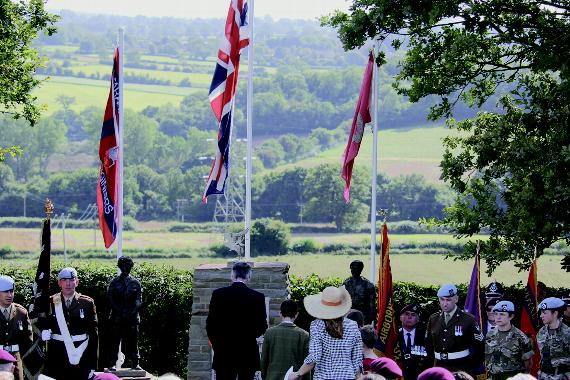
High-ranking dignitaries and community groups from the local area came together last Sunday to mark the fortieth anniversary commemoration of the Double Hills Arnhem Memorial, which was first unveiled in 1979. Sadly, due to a dwindling number of veterans being able to attend, this is expected to be the last ceremony of its kind – with efforts instead to focus on the refurbishment and upkeep of the Memorial.
Each year, the ceremony has paid tribute to the first British casualties who died in an air crash at Double Hills, when a Horsa Glider of the British First Airborne Division with 23 service personnel on board, all lost their lives. They were en route to Operation Market Garden and the Battle of Arnhem on Sunday, 17th September 1944. The memorial and annual ceremony has been organised over the years by Peter Yeates and a dedicated committee. This year’s commemoration included a performance by the Midsomer Norton and Radstock Silver band, parade and salute and a flypast by the Army Air Corps’ Historical Aircraft Trust.
Reader, Allan Curtis has been in touch with The Journal to share what he recalls about that day, in 1944, as a five-year-old boy. Playing football outside his home, he witnessed a sight that has remained with him forever.
Thank you, Allan, for sharing.

.png?width=209&height=140&crop=209:145,smart&quality=75)
When I arose on Sunday, 17th September 1944, it was a happy and joyful day, but unfortunately not for too long.
Two of my three serving sisters were on leave together, something that rarely happened and seemed to be a miracle. My sister, Mona, was serving in the ATS and was a Corporal; my sister, Amy, whose birthday it happened to be, was in the WRAF. Before the war, she was a nurse in St Martin’s Hospital in Bath, but this was a reserved occupation, so she left nursing and joined the forces, driving huge lorries. Next door, my grandmother was dying, and her son, my Uncle Lloyd, was home on leave. She was very bad with cancer and would not live much longer.
After a while, my younger brother, Phillip, myself and a couple of neighbouring children went out to play football. It was not really football – it was kicking a tennis size ball up and down the road and if you could kick it past the opposition, you had scored a goal. There was no danger then, as there was only about one car in the village; the American troops were now in Europe with our army, leaving only the police to worry about, as they would come along in their Wolseley car and shout at us over their loud speaker!
On this Sunday morning we were playing football as usual, when an increasingly loud sound stopped us as we all looked to the sky. Dozens of planes pulling gliders blackened the sky with a noise which brought the neighbours out to see what was happening as the flight of planes came towards us in a south westerly direction from Weston-super-Mare.
We joined my sisters and uncle to watch, when suddenly, one of the leading gliders started to fall apart in mid-air, dropping down to a crash landing at Double Hill.
My sisters and uncle immediately started as quickly as possible to see if they could save anyone from this disaster, especially my sister, Amy, who was a nurse (as I explained before). As it was only two fields away, I was not going to be left behind, but I soon lagged, as my five-year-old legs would not keep up with trained soldiers.
Farrington Gurney was in the Somerset coalfield, and although the Farrington mine was closed in 1920, it left a large, high mountain of spoil from mining operations, but has now been lowered and is a trading estate. Suddenly, the towing aeroplane started flying low around the spoil heap, frightening me so much I now ran as fast as I could because it was so loud, I thought it too would come down. I’ve no idea why it kept on circling the spoil heap – was it to make sure all of the fleet behind got safely by, or was the pilot reporting back to base to tell what had happened? Only the pilot would have been able to say. (I have since heard from other eyewitnesses that the towing plane was instructing civilians to keep away from the crash site as there were bullets on board).
I didn’t get much further before there were two very loud blasts, as something on the crash site exploded. This really finished me off, and I turned around and ran home to my parents as fast as I could. I was now, in my mind, safe.
A couple of hours later, my sisters and uncle came home, and when asked by everybody if they had succeeded in helping, the answer was that the heat when the blasts occurred made it impossible to help anyone on board – it had been impossible to get close due to the overbearing heat, and they knew that there would be no survivors.
My father was a miner who originally came from Paulton and liked to drink in the village with his mining buddies. A few days after the terrible Sunday happenings, he took me with him when he went for a drink – only a lemonade, if I was lucky. On the way, we passed the field which had seen the disaster, and along the left hand side of the road to Paulton were the parts of the glider that had fallen in mid-air, put in a neat pile ready to be picked up by those in charge.
About two Sundays after the disaster, a service was held at St John the Baptist Church in Farrington Gurney. The church is not small, but on this occasion, a huge congregation attended. Chairs had been brought from Farrington Gurney Memorial Hall (now taken down and replaced by a new building) and laid all around the sides of the church. Even this did not solve the problem of the number of people wishing to be at the service. A man gave my mother his chair next to the font and I had to stand. It was here that a bugler sounded The Last Post, although I did not know what it was called at the time. It was obviously important, because all the members of the large army contingent stood as this happened.
Forty years ago, a memorial was erected in a field a couple of hundred yards from where the glider landed. A service is held here every year with Army officials and a fly past, with the plane passing over the gathering. This would be a week or so before or after September 17th, as the army holds its own Remembrance Service for all those who perished in the Market Garden battle to which the glider was heading.
Allan Curtis
Comments
This article has no comments yet. Be the first to leave a comment.