

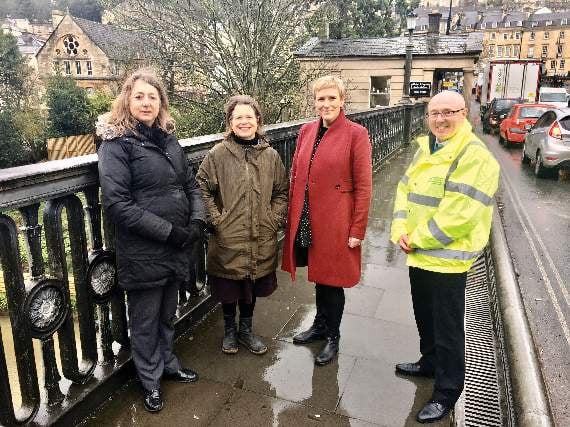
Bath and North East Somerset Council has successfully secured £3.5 million funding to carry out essential repairs to the city’s historic Cleveland Bridge.
The funding was announced as part of a £93 million Government boost to connectivity, ensuring England’s roads are fit for the 21st century.
Roads Minister, Baroness Vere, who made the announcement, visited Bath and met Council Leader Councillor Dine Romero, and joint Cabinet Member for Transport, Councillor Joanna Wright.
The council is among thirty-two local authorities which will receive investment for essential repair works to level up infrastructure.
.jpeg?width=209&height=140&crop=209:145,smart&quality=75)

Currently the 194-year-old bridge has a temporary eighteen tonne weight restriction on it affecting heavy goods vehicles and larger coaches, which is being enforced by police spot-checks.
Surveys show some structural parts of the bridge have come to the end of their life and the weight restriction has been introduced to prevent further deterioration of the bridge and increased cost of repairs.
Roads Minister, Baroness Vere, said: “There is nothing more frustrating than a journey delayed by poor road conditions, and this multi-million pound boost will help improve connectivity across the country. This investment will not only help local areas to target current pinch points on their roads, but will also harness our world leading research and innovation capabilities to future proof the next generation of journeys.”
Bath Councillor, Joanna Wright, joint cabinet member for Transport Services, said: “We will now be able to move forward with our urgent plans to repair Cleveland Bridge by appointing a contractor and finalising details of the work, which we hope will begin in early April.
“The bridge is a strategic part of the highways network to keep traffic flowing for motorists and this funding will enable us to secure the bridge’s future. We would like to thank our colleagues at the West of England Combined Authority for their support in this bid.”
Currently, signed diversion routes, using designated roads suitable for large vehicles, are in place for through traffic, while those vehicles needing to go into Bath city centre will be directed to the city from the west using the A4. The distance on the diversion from Bath to Warminster is twenty-five miles; the normal distance using the A36 is seventeen miles. The diversion would add eight miles to journeys for traffic heading to the south.
The bridge was originally constructed in 1826 for horse- drawn vehicles and pedestrians and now carries 17,000 vehicles a day, including more than 600 HGVs.
The repairs to Cleveland Bridge will require one of the most significant road maintenance projects the council has undertaken for many years.
Comments
This article has no comments yet. Be the first to leave a comment.