

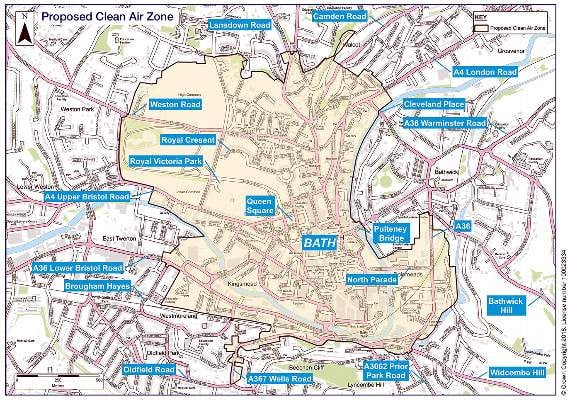
More than 5,000 people have had their say on plans to charge polluting vehicles to enter parts of Bath – but what happens now?
The Clean Air Zone Consultation closed on Monday, and Council Cabinet Members now have twenty days to consider the responses before they meet on Tuesday, 18th December.
Bath and North East Somerset Council has until the end of the year to submit its final plan to cut the city’s dangerous levels of nitrogen dioxide. It was one of 28 local authorities ordered to do so by Government in “the shortest time possible”, and by 2021 at the latest.
The next step will be to draw up a full business case, after which it is “not anticipated that significant, if any, alterations will be made.”



The authority’s preferred option is to charge non-compliant cars, taxis and vans £9 a day and to levy a £100 charge on buses, coaches and lorries entering the zone. Its outline business case says charging to enter a Clean Air Zone is the only mechanism capable of reducing emissions to appropriate levels.
But the six-week consultation has highlighted a wealth of concerns – including that the charges are a “stealth tax” that will hit the poorest hardest and could force businesses to go under, that drivers will take rat runs to avoid the zone, and that people will have to pay to go to hospital.
B&NES Council’s own consultants said the impact to the local economy over a decade could be as much as £133 million. But it could face fines or legal action if it fails to improve air quality.
While the complaints may be extensive, the business case says it is better to hear them now, rather than when the plans are more advanced, when they could trigger the need for a public inquiry.
Council papers say: “The final business case will be the next phase of the project and is anticipated to be progressed during early 2019. This will finalise the proposals for a charging clean air zone and set out detailed issues around the implementation and operation of the scheme.
“Importantly, during the final business case stage the order required to legally designate the charging zone will be advertised and consulted on, sealed and ‘made’. It is not anticipated that significant, if any, alterations will be made to the scheme during the full business case stage.
“Engagement during this stage will focus on raising awareness of the clean air zone and the need for action, and helping people to get compliant in cost-effective ways, find alternative ways to travel around Bath, change their travel habits and understand the important role that everyone can play in tackling air pollution.”
The papers indicate that the clean air zone will come into force on 4th December, 2020.
Stephen Sumner
Comments
This article has no comments yet. Be the first to leave a comment.