
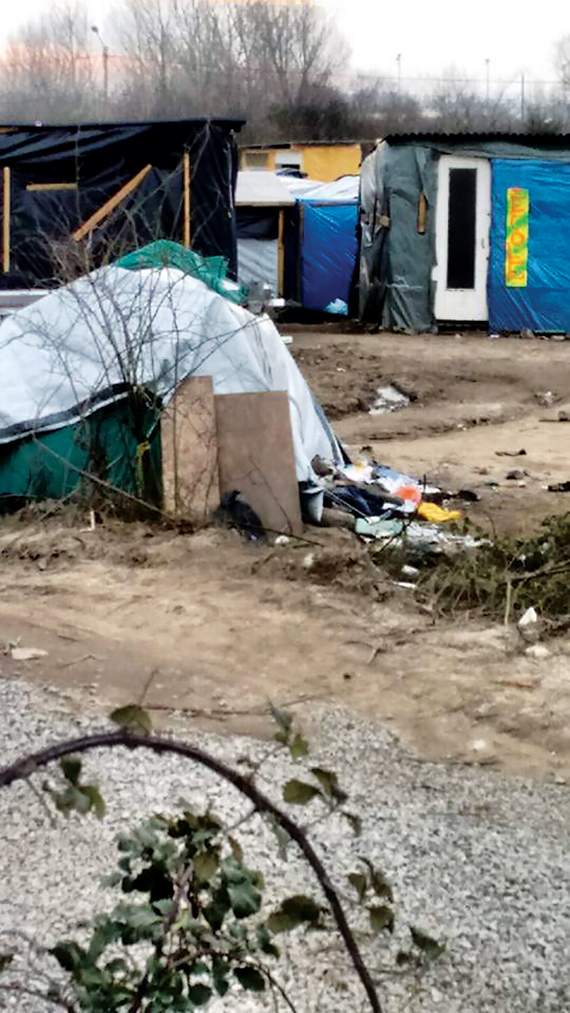
Deeply touched by the plight of refugees fleeing war-torn countries and the growing migrant crisis in Europe, Radstock couple, Helen and Simon Allen, decided that rather than hearing, reading or watching stories, that they would travel to and see for themselves, what is now known as the Calais jungle, a makeshift camp or no man’s land, where refugees have found themselves stranded after making perilous journeys to come as far as they have – many losing family members crossing seas and experiencing extreme trauma from events in their homelands.
Along with another volunteer, Mike Clarke, the couple loaded up their car with supplies and set off, having first co-ordinated with the response group, Calais Action South West. “It’s really important that volunteers don’t just turn up,” explains Helen. “There are people that are well-meaning who turn up with car loads of supplies but actually, it causes chaos and can get out of hand, people there are so desperate – they are just trying to survive.
“We had the opportunity to go and volunteer from Thursday through to Sunday,” adds Helen. “The pictures in the mainstream media don’t necessarily represent what is happening out there and on a more personal level, we wanted to understand the situation and to try and be as helpful as we could in a short space of time. On the TV you see lots of conflict, but what you don’t see are the families and unaccompanied children living in these dreadful conditions.”
When Simon and Helen arrived in Calais, they spent the day sorting through a warehouse, which has direct contact with the elders in the camp on a daily basis, so that there is an accurate and up-to-date picture of what is needed. The couple spent their first day sorting through clothes and donations that had come in from across Europe.


.jpeg?width=209&height=140&crop=209:145,smart&quality=75)
“It is an extremely organised, focused centre for donations, all run by volunteers, as there are no major charities out there,” says Helen. “Many of the volunteers are living in caravans and have given up everything to go and help. There is a workshop where shelters are being built out of pallets – the warehouse is an incredibly well-oiled machine, but the situation is continuously ongoing and is completely relentless.
“They are in desperate need of good quality walking shoes, waterproofs and four season sleeping bags. It was -4 when we arrived, so it can get very cold. But what the refugees need changes weekly and so if people do want to donate, the best thing they can do is donate money – and then Calais Action South West buys the things needed at that particular time – it is an immediate response and the money does not sit around.”
Helen, Simon and Mike then spent the following days volunteering in a community kitchen, set up by a Bath local, and were immediately cooked a meal by a refugee who was a chef in his homeland. They report that there are tin churches being built on site by its inhabitants, schools where English is taught, a ramshackle play park and community makeshift restaurants have also popped up. “You might think that this is a good thing,” adds Simon, “but it shows that the situation has gone on for far too long.
“These are well educated, skilled individuals, most of whom would give anything to go home. But home doesn’t exist for the majority any more. The numbers fluctuate, but there can be anything between 3,000 and 7,000 people there – effectively, a town the same size as Midsomer Norton.
“There are many different cultures, with refugees from around the world all in one place and unaccompanied kids who are just trying to reach other members of their family in other parts of the world. If you had lost everything and had one family member living elsewhere in the world – wouldn’t that be the first person you would then turn to?”
Working alongside other refugees, the team in the kitchen were responding quickly to what was needed every day, in terms of food and gas supplies with which to cook it. From this one kitchen alone, they were serving 800 meals a day. “It was here we began to hear their personal stories,” said Helen. “There were young boys who could speak three languages and had worked as translators and been through the most awful experiences to get to Calais – one had lost four family members who had drowned trying to reach Europe.
“They have formed friendships in the camp as they are trying to make the best of it, but in every single person we met – you could see at some point the trauma and the weight of what they were carrying in their faces.
“Their lives weren’t that different from ours once. They had family, fun, dreams and ambitions, but the longer they stay, the more difficult it will be for them – the camp is a public health disaster waiting to happen, although vaccination programmes are beginning. There is already measles, scabies, flu and HIV present. Every night, they are risking their lives to try and get out – and you see many people with broken limbs and injuries as a result.
“There are hundreds of armed police and a thirty foot high fence – and those guarding it are frightened, too. These people have nothing to lose and are desperate, so there is often tear gas which spreads across the camp and affects the children.
“I would challenge anyone to go and not be engaged and moved by these people, who all have their own stories to tell. There’s no difference between us and their families and communities. It is the best of humanity in a really bad situation and it both lifts the heart and haunts your soul, all in one minute. The road ahead is closed and hostile, but the road behind them is completely obliterated.”
“We all want the same thing,” says Simon. “Our families, a roof over our heads and food in our bellies. All the other stuff is peripheral. We just want others to know that we are all more alike than different and to show the human side of what we experienced, rather than what you might see on the news.”
Both Helen and Simon are planning on returning to Calais at some point to carry out further voluntary work. Calais Action South West is constantly looking for donations of money or clothing, drivers to transport donations and can point people in the right direction if anyone wishes to volunteer their time via the French charity, L’Auberge des Migrants or care4calais. There is also a need for medics, therapeutic support and builders. For more information, search for Calais Action South West via Facebook.