
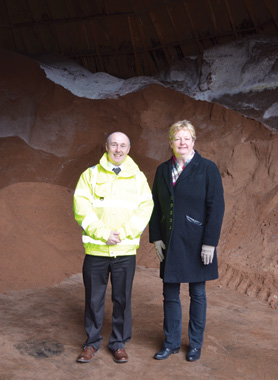
The salt storage facilities run by Bath and North East Somerset Council are now at record capacity in preparation for a tough winter on the area's roads.
Some 2,300 tonnes is ready for spreading by the Council's nine-strong fleet of gritting vehicles when temperatures plunge. Over 38% of the road network is salted by the Council – this totals 261 miles of highway and is 8% higher than the national average, supplemented with over 400 grit bins also available for the public to access salt. So far, the gritters have been out six times since the end of October. Smaller roads and lanes are tended to by farmers and Snow Wardens, who have received special training and equipment from B&NES in order to look after smaller communities.
In the event of snowfall, the Council redeploys staff to assist with snow clearing and can operate the gritting fleet around the clock to ensure the maximum levels of support is given to residential and business communities across the district. The gritters aim to complete their round in three hours to ensure the minimum amount of disruption.
Councillor Caroline Roberts (Lib-Dem, Newbridge), Cabinet Member for Transport, said: "For the past few months, Bath and North East Somerset Council has been busy preparing for a harsh winter. Our increased salt storage means our gritting on prioritised routes can continue for longer. We're also very grateful to members of the Council's Snow Warden Scheme, the initiative encouraging people to volunteer to help clear snow and ice the Council can't get to."



A substantial amount of information is available on the Council's website http://www.bathnes.gov.uk/gritting">www.bathnes.gov.uk/gritting – including a winter advice leaflet offering tips on dealing with severe winter weather on highways and pavements. This includes Government guidance on householders clearing snow and ice outside their home.
Kelvin Packer, Council Group Manager for Highways and Traffic, said: "We are able to maximise our salt supply by regularly turning it over in the barn to maintain its shelf life, as well as moving our emergency supply into the barn before it deteriorates and using calibrated spreaders on the gritting machines to ensure not a grain is wasted.
"We are monitoring the weather forecast 24 hours a day, using real time data from two weather stations. We also obtain detailed forecasts from a specialist supplier of weather information about the likely effect on road conditions. The Council is well prepared to ensure our priority routes are gritted, so that people can get around the road network as safely as possible."
The Council try to prioritise major roads, such as hospital routes and public transport routes, as well as steeper and more dangerous roads to ensure resident's safety. Should residents be concerned about their roads not being cleared and needing to get to a hospital or similar emergency, they can contact the Council, who will liaise with emergency services and the gritting teams. When the weather is particularly bad, wider vehicles are used to help with the clearing of snow, which can be problematic with parked cars lining roads. In the event of heavy snow, it is recommended that cars be moved from the roadside, if it is safe to do so, so that the vehicles can clear the road efficiently.
During any severe winter weather, the Council provides regular updates about the status of its services on http://www.twitter.com/bathnes">www.twitter.com/bathnes The public can also play their part in helping the Council to manage the road network during severe weather. They can report any problems via the web: http://www.bathnes.gov.uk/reportit">www.bathnes.gov.uk/reportit by email: [email protected]">[email protected] by Twitter: @ccbathnes by text: 07797 806545 or by calling: 01225 394041 during working hours. In an emergency, please call: 01225 477477.
In other road news this week, Fortescue Road, in Radstock, reopened last Friday following completion of work by Wessex Water. Original signage, bus stops and traffic flows are now back to normal and The Street has changed back to one-way.