
“I can refer to an old programme I’ve got in front of me, which was actually issued on 19th of November 1937, where the notes state ‘we believe it is a fact that Radstock Football Club was started in 1835’, which is before Sheffield FC and before various others around the world. We’ve got no concrete evidence of that; the first real evidence of matches being played is in 1880-something. But this is a programme with notes and from people who were still alive at the time when they were written from 1835.
So, it would be lovely to find any evidence of playing that early, but our records show that the club was actually playing as Radstock Sports Association in the early 1880’s.
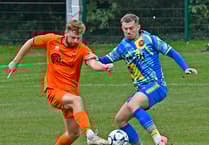
“We’ve got match reports against Shepton Mallet in a game in 1883, which Shepton won on a hotly-contested corner count. The game finished actually on two goals each, and then it was a four-two corner count in Shepton Mallet’s favour, which apparently were part of Football Association rules at the time. Of course, at that time, we didn’t have one set of rules, I mean, there was a set of rules for up North and a set for down South, and the Football Association in London were trying desperately to pull it all together. But those were the first games and we certainly played quite a regular fixture list then.
Fixture Secretaries were very important because although there were no league teams, arranged games and financial commitments were made.

“There’s a really nice bit of information in one of the press reports of Radstock Town visiting Bradford-on-Avon who’d agreed to compensate Radstock should the crowd not reach a certain level.
“In 1889, the club changed its name to Radstock Wanderers and started playing Somerset League football in 1890/91. Then, in 1895, they became Radstock Town and affiliated to the Somerset FA. At the time, the Vice Chair of the club was Charles Lewin, who, of course, went on to be the first Chairman of the Somerset FA, and I think the youth team still play for the Lewin Cup. So, the history is a long one, and it’s a fascinating one in lots of ways.
In as much as the club’s had its ups and downs, it went out of business for a little while in the early 1900s because of a lack of income in effect, and of course, the mining industry wasn’t as buoyant, shall we say, as it became later on. Certainly, the effects of Lord Carlingford and Earl of Waldegrave, their demands on the miners in terms of hours worked and pay given meant that sport often took second place.
“So, Radstock Town football club as such, and football being played in Radstock, was probably some of the first played in the North Somerset area.”
Next week Dave will be talking about Radstock’s move to the current home, Southfields Recreation Ground.
If anyone has any information, photographs, old programmes, newspaper articles or medals concerning the history of Radstock Town Football Club, then Dave would like to hear from you, as he continues to compile the Club’s history. Dave can be contacted at: [email protected]
Ian Nockolds
Comments
This article has no comments yet. Be the first to leave a comment.