

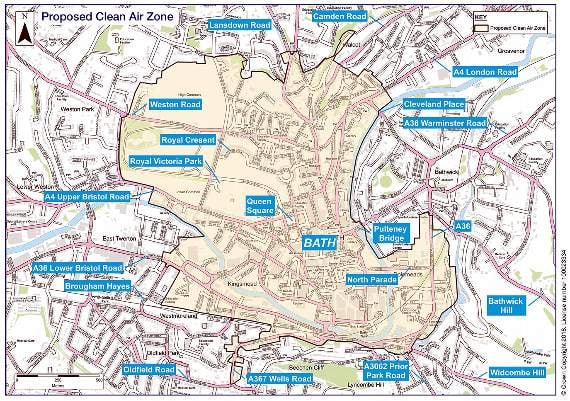
A resident has claimed the public was denied a key piece of information until after the consultation closed on Bath’s proposed clean air zone.
Resident, Chris Beezley, claims a financial report seems to show that the only way to make the scheme viable is to charge car owners, who could pay three-fifths of the fees and fines.
Bath & North East Somerset Council has confirmed that the document was only published in a redacted form on 14th December – after the public consultation closed and days before cabinet members were due to make a decision.
But it said much of its contents were previously available to residents, and it has strenuously denied that a decision on the proposed Clean Air Zone is financially driven. It says any revenue shortfall would be met by Central Government.



Mr Beezley said the finance report shows there is “no alternative” to a class D Clean Air Zone, one that charges all types of higher polluting vehicles to enter – including cars. If an alternative Clean Air Zone model was adopted – referred to as class A, B or C and not charging cars – the figures do not add up, he claimed.
Mr Beezley said: “Given its major relevance to the clean air issue, why was the illuminating financial report hidden from public view until after the consultation period?
“Was it because it does indeed show that the only financially-viable clean air zone for Bath is Class D? If so, the public have been misled into believing that there was a choice of different Clean Air Zone options to consider.”
The finance report says that over the ten-year lifespan of the Clean Air Zone, the operating costs are expected to be £28 million.
Of the £55 million expected income from charges and fines, £33 million would come from cars – which would not be paid if a class C zone, that charges higher polluting buses, coaches, taxis, vans and lorries but not cars, was introduced.
A Council spokesperson said: “The financial case section of the outline business case was published at the outset of the public consultation on 17th October, 2018.
“Because the financial report contains commercially sensitive information it, was not published immediately, however, during the consultation, it was reviewed and published with redacted information on 14th December.
“Much of what it contains is already in the financial case section of the outline business case. The document was not withheld.
“Over the past year, the Council has been open and transparent about its Clean Air Zone proposals, and has kept the public informed at each stage, resulting in a consultation which generated one of the largest responses the authority has seen.
“This includes explaining that Central Government is funding the design and implementation of the scheme, including any revenue shortfall.
“Any surplus revenue must be reinvested in transport-related schemes, in accordance with the spending plan set out in the charging order – this is not a revenue generating exercise for the Council.
“Any estimated revenue shortfall would be met by Central Government.
“Finally, to suggest the Council’s decision on this significant scheme to improve public health for the people living, working and visiting Bath is based upon financial considerations is disingenuous and misleading; it does not give recognition to the complex work being undertaken to achieve compliance within the ministerial direction from Central Government.”
Mr Beezley said he was not opposed to the Clean Air Zone and that he agreed with the need to bring down nitrogen dioxide levels.
But he added: “There seems to be a desire to get well under the legal limit rather than meet it.
“The legal limit is set for a reason, and there are no bonus points for exceeding it.
“Indeed, bearing in mind the predicted £133 million negative effect of a class D Clean Air Zone on the Bath economy – in addition, of course, to the other economic pressures that businesses in Bath are already under – it is difficult to understand how those calling for such an extreme and disproportionate zone give one jot for the local economy.
“B&NES Council itself should be very alert to this, given the high percentage of its revenue that comes from businesses.”
Mr Beezley suggested these alternatives to a Clean Air Zone, that other cities have introduced:
• Traffic management schemes to reduce flows through ‘problem’ streets
• A ‘mobility credit’ scheme offering residents free public transport – with a larger credit for owners of cleaner vehicles
• Encourage early uptake of electric/hybrid vehicles by providing more charging points (including businesses)
• Targeted scrappage scheme
• Workplace parking levy (ring-fenced) on all employers who provide more than ten parking spaces
• Improved routes for walking and cycling
• Electrification of railway through the city
• Tackling unnecessary vehicle idling, especially outside schools
• Investing in cleaner buses, council vehicles and ultra-low emission taxis (including ULEV-only taxi ranks)
• Promote safe routes to school to reduce school-run car journeys
• Promote more travel plans – including all schools
• Establish a Clear Zone in the city centre to prevent general traffic from accessing central core between, say, 10 a.m. and 4.30 p.m. – with special access permits needed for loading/unloading.
Mr Beezley added: “For Bath, of course, key non-charging methods include the missing eastern Park and Ride and A36/A46 link road!”
B&NES Council’s Clean Air Zone consultation closed on the 26th November deadline last year.
S. Sumner, LDR
Comments
This article has no comments yet. Be the first to leave a comment.