.jpg?width=94&height=94&crop=1:1,smart&quality=75)

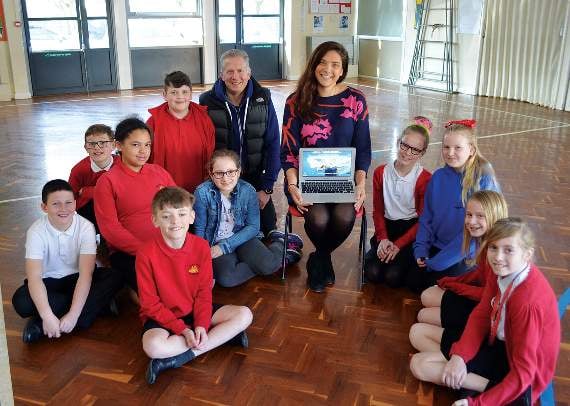
Westfield Primary School received a very special visitor last week, in partnership with Journal Editor, Becky Brooks.
Dr Claire Petros arguably has one of the best jobs in the world – she is a veterinary surgeon working alongside the Olive Ridley Project; a charity saving turtles from ghost nets in the Indian Ocean, and specifically, in the very beautiful Maldives.
Becky and Claire met by chance last September through the scuba diving community at an Underwater Festival. As part of her work with the charity, Dr Petros has been visiting schools wherever she can, working to spread the message about the harm that plastics cause to our oceans. In the Maldives, this takes the problematic form of ‘ghost nets’, aptly named because no-one can really be sure where they are coming from, but which drift up through the Indian Ocean, trapping ocean wildlife with devastating consequences.
It is thought there are around 640,000 tonnes of plastic netting lost annually, and plastic in our oceans has become a huge topic recently, with series such as Blue Planet highlighting the effect to the masses. As a result, more of our ocean creatures are being studied, and turtles are no exception – over one hundred pieces of plastic have been found in one turtle alone.
Turtles can also end up being entangled in ghost netting, often sustaining horrific injuries to their flippers trying to escape. Many will die before they are found, or cannot be saved by the time they are discovered in the ocean or washed ashore. With over a hundred turtles reported entangled in nets in the Maldives alone each year, and given they have such a low survival rate (only one in a thousand hatchlings will make it to adulthood), this is a worrying statistic.
The Olive Ridley Project was founded in 2013 by biologist, Martin Stelfox, moved by his experiences in the Maldives. In February 2017, a Marine Turtle Recue Centre was set up in Baa Atoll, and responding to an advert on Facebook, Dr Petros found herself heading up the newly-established veterinary team there.
Studying Biological Sciences at Oxford and completing her veterinary training at Bristol University, Claire Petros specialised in marine ecology. Now extremely well travelled, Claire’s studies saw her travelling around the globe, studying coral reefs in Indonesia, working at a spay clinic in Thailand, and gaining valuable experience with the exotic veterinary team at North Carolina State University, where her love of turtles really took off. She then spent time in Grenada, working as a research assistant for the Wider Carribbean Sea Turtle Conservation Network, a research centre for leatherback turtles.
Now spending her time between the Maldives, London and Bristol, Claire has been travelling the world learning as much as she can about her beloved turtles, and taking this knowledge back to the Olive Ridley Project, inbetween collecting data, taking care of the centre, operating on and rehabilitating turtles, and carrying out day-to-day tasks such as cleaning the tanks! At one time, Claire was the only vet in the Maldives, and is the first UK vet to be working there. Such was her demand, that she was asked to vaccinate all of the local police dogs against rabies, and she used her contacts to begin sourcing equipment for the new rescue centre, such as veterinary drugs, an x-ray machine and other essential items.
Importantly, she is also spreading the word and taking the environmental message out to Maldivian schools, locals, and back here in the UK, too. Most recently, Claire undertook a paddleboard challenge as part of the ‘Stand Up for Our Seas’ initiative, which saw her travel 100 km as part of a team of four around sixteen islands, highlighting the message of plastic pollution, carrying out beach clean-ups, speaking at local schools, and luxurious Maldivian resorts for guests to take the message home with them. She is soon to begin a PhD sponsored by OceanCare on sea turtle rescue centres.
Back in the UK, and at a visit to Westfield Primary School last week, Dr Petros gave a talk to the children at a special assembly, teaching them all about turtles, the threats they face, and the work done to rehabilitate and release them back into the ocean. They learnt about plastics and how long they take to break down over time. It can take up to four hundred years for a plastic bottle to disintegrate, leaving harmful chemicals in its wake; drinking straws can take around two hundred years, and some plastic bags up to a thousand years. The children gave suggestions on how to tackle the plastic problem at home, by using reusable bags, cups, straws and bottles and taking care of our environment. She then visited separate classes answering questions – and there were some very interesting ones!
Speaking about her work and how she reached this point in her career, Claire said: “I think I was probably an annoying child that had to touch and play with any animal that I walked by! My parents weren’t animal lovers at all, but I loved watching David Attenborough programmes and Vets in Practice. I always wanted to be a vet from a really young age, and work outdoors.
“I love working with the turtles, each has its own personality. My favourite so far we named Beyoncé, having found her on International Women’s Day, and she was certainly a fighter! We tend to receive around thirty to fourty turtles a year, but we have had thirty at the centre already, in just three months.
“We are now hoping to begin tagging the turtles, to find out where they go and what happens to them after they leave us – but each GPS tag costs around £5,000, so it will be very costly.
“I think people are finally starting to wake up to the problems we have surrounding the ocean environment – it’s slow and steady, but the world is beginning to sit up and take notice. Whilst the odds are sometimes stacked against our turtles, what we are doing is most definitely worth it – even if one hundred survive, that’s one hundred that wouldn’t have done if we hadn’t tried.”
Inspired by her visit, the children at Westfield Primary School are now hoping to write letters to lobby the Government, and may well be adopting one of the Olive Ridley Project turtles in future; perhaps connecting up via webcam with Dr Claire in the Maldives to find out how their turtle is getting on. If you would like to find out more about the Olive Ridley Project, visit: www.oliveridleyproject.
org, or find them on Facebook to follow the progress of some of the turtles at the centre. You may even spot a familiar vet!
Comments
This article has no comments yet. Be the first to leave a comment.