

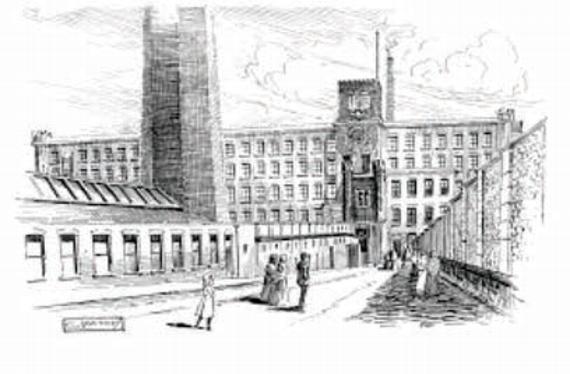
Cotton mills are generally associated with the northern towns of Lancashire, Yorkshire, Cheshire and Derbyshire, not Bristol. However, it was in Bristol that the largest of them all was built on a site in East Bristol, at Barton Hill, as we were to learn from Garry Atterton, our speaker for the January meeting.
It was the building of the feeder canal that was the catalyst to open up the area for the development of industry in Barton Hill, and was the site chosen to build the Great Western Cotton Mill.
Finance to build the mill was provided by several of the prominent Bristol businessmen, many of whom were involved in the slave trade. When slavery was abolished in 1833, the Government paid compensation to the slavers, much of which was invested in the mill. Overall, an equivalent sum of £7.2 million was paid to them. The bales of raw cotton came from Southern America by sea to Liverpool, and then by canal, sea or rail to the mill.
The factory was five stories high and built in 1837, and opened in April 1838. The first piece of cloth produced was presented to the Mayor of Bristol, Mr Haberfield. To get production started, expert workers, many of them women, were brought in from northern England to operate the specialist machinery. By 1840, the factory employed 958 people, including 609 girls, 113 boys, 117 men and 119 females. Conditions were noisy, arduous and dangerous, and the pay was poor.


Despite all this, Garry was able to interview a couple of ladies who actually worked in the mill and they said there was a strong community spirit amongst the workers, which they thoroughly enjoyed. Employers also paid for occasional trips to Weston-super-Mare or sometimes, Bristol Zoo.
The mill was subject to many strikes between 1858 and 1900, usually over pay cuts or pay not being in line with the northern mills.
Cottages were built in Barton Hill to house many of the workers, some surviving to this day. However, a lot were demolished in the 1950s, when the area was redeveloped.
Between 1861 and 1865, because of the American civil war, the Southern ports were blockaded. This meant that no cotton was being imported, which led to the closing of the Great Western mill in 1863.
Between 1925 and 1929, the factory was used by the Western Viscose Silk Company and it became a shadow factory in the war years of 1939 to 1945. In 1968, the mill was demolished.
This was a well-illustrated and well-researched talk which was greatly enjoyed by those present. The group will meet again in Clutton Village Hall at 8 p.m. on Tuesday, 11th February. The speaker will be John Smith, with a ‘Show and Describe’ presentation entitled ‘Battle of Britain over Somerset 1940’. Visitors are always welcome with a small entry fee, which includes refreshments. For more information on any of the above, please telephone: 01761 471533. Terry McGill
Comments
This article has no comments yet. Be the first to leave a comment.