
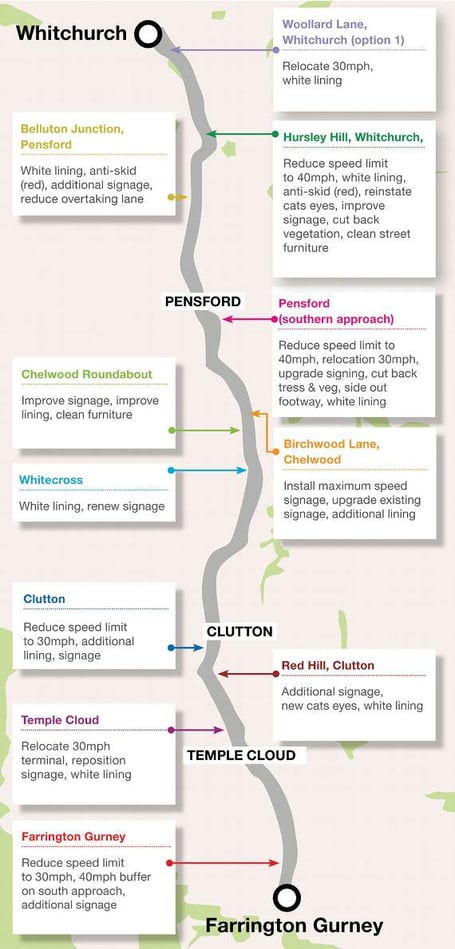
The busy A37 from Whitchurch to Farrington Gurney, which carries over 18,000 vehicles per day, will be the first road to benefit from a new approach by B&NES Council’s engineers to improve road safety along an entire corridor. Over the next two years, £138,000 worth of road safety engineering work will be carried out, which will include new white lining, anti-skid areas, improvements to current and additional signage, reinstating cats’ eyes, cutting back vegetation and reducing the speed limit in both Clutton and Farrington Gurney from 40 mph to 30 mph.
The Council has said this is a ‘pioneering’ new approach, with the initiative involving assessing collision data along the whole road length to produce a single programme of work. It will also enable Highways to weigh up the costs and benefits that will come from the proposed works, which is hoped will reduce traffic speed, cut accidents and save lives, protect pedestrians, and also save an anticipated £614,000 of public money through a reduced need of accident and emergency services responding to incidents.
There have been ninety recorded collisions on this stretch of road across a five year period and B&NES is predicting that this safety work could cut the number of road accidents by more than a quarter.
The proposal will also mean that works will be co-ordinated in a way which will minimise disruption for commuters and is likely to become a blueprint for future road improvements in the area.


As well as the work to improve road safety, B&NES is also undertaking overnight resurfacing of part of the A37 through Pensford later this month.
In response to concerns from local residents, Parish Councils and Ward Councillors, the Council’s Road Safety Team has been working with the community and Avon and Somerset Police to work on safety recommendations for the road, which includes reducing speed limits.
Councillor Tim Warren, (Conservative, Mendip), Leader of the Council, said: “The A37 is one of our busiest roads in the area, carrying over 18,000 vehicles daily.
“I would like to thank the Police and Ward Councillors who have been instrumental in supporting us to develop this scheme. By working closely together, we have been able to come up with a new approach to saving lives across an entire road network. I see this integrated approach, working with the community – who best understand the local issues, as a model for future road safety schemes and projects to tackle congestion.”
One of the new measures which the Council plans to put in place is a new 30 mph limit through Clutton village. Clutton Councillor, Karen Warrington (Conservative), commented: “Road safety and speeding is a real concern for residents in Clutton. The current 40 mph speed limit is too high for a village with numerous pedestrians and children crossing the road, so I’m really pleased to see the Council putting in place these long-overdue plans to bring the speed limit down to 30 mph.
“This is a real victory for those who have campaigned for this over many years.”
Farrington Gurney is also set to see the speed limit reduced to 30 mph on the A37 through the village. Local Councillor, Les Kew, (Conservative, High Littleton) said: “The most sensible speed when driving through a village is 30 mph, so I welcome the Council’s proposals to bring Farrington Gurney into line with most other villages by reducing the speed limit from the current 40 mph.”
As work progresses along the A37, B&NES Council says its officers will continue to monitor accident data, work closely with Ward and Parish Councillors to keep local people informed of the works and to minimise disruption to residents, as well as linking closely with the police to ensure that road users comply with the new speed limits.
Improvements by area – Farrington Gurney: reduced speed limit of 30 mph with a 40 mph buffer on southern approach, additional signage. Temple Cloud: Relocate 30 mph terminal, reposition signage and white lining; Red Hill, Clutton: Additional signage, new cats’ eyes and white lining; Clutton: Reducing speed limit to 30 mph with additional lining and signage; Pensford’s southern approach will also see a speed reduction to 40 mph, a relocation of 30 mph and an upgrade of signage and markings.