
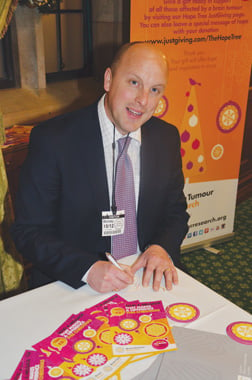
A select group of MPs, brought together by the national charity, Brain Tumour Research, met with campaigners at the House of Commons to highlight the discrepancies in cancer research funding on 15th December.
MPs were presented with a set of stark facts and the charity will encourage a discussion on how the Government can improve outcomes for the 16,000 people diagnosed with a brain tumour each year.
Tragically, brain tumours are the biggest cancer killer of children and adults under forty and yet, national cancer research spend on brain tumours is just 1%. Five-year survival rates for brain tumour patients lag behind other cancers at just under 20%, while the average across all other cancers is 50%.
Joining Brain Tumour Research at Westminster was Andrew Stammers, from Radstock. Following a seizure in 2011, Andrew was initially diagnosed with a low-grade brain tumour. Using pioneering surgery, the tumour was removed while Andrew was awake, however, another blow was to come, as tests showed the tumour to be aggressive and it is likely to return.




Father of three, Andrew, said: "Being diagnosed with a brain tumour is like being on a rollercoaster, consultation after consultation, diagnosis, different treatments and ongoing scans resulting in huge emotional upheaval for me, my family and friends. I know there is a direct correlation between investment in cancer research and increases in survival rates; look at how prognoses have improved for patients diagnosed with breast cancer over the years, but this logic has yet to be applied to brain tumours.
"I will be asking MPs why are brain tumours so over-looked? Do they have a message I can take home to my children that gives them hope? Can I tell them more will be done to understand this devastating disease?"
The event, organised by Brain Tumour Research, outlined key policy changes the Government could make to champion the fight against the disease, including: a pledge to increase research funding to £30–£35m a year over ten years and a new national register of research, which tracks all research work and grants with the aim of reducing duplication, increasing transparency and highlighting the shortfall in disease areas.
Discussions also focused on what more could be done to fund PhD research scholarships, the need to ringfence the medical research budget and a call to streamline the process for repurposing drugs, which means medicines already being used for treatment of other conditions could be more readily available for brain tumour patients.
Sue Farrington Smith, Chief Executive of Brain Tumour Research, said: "We have a clear set of recommendations for MPs. We need a clear plan from the Government to kick-start the changes that are needed to give patients the knowledge that more effective treatments are being identified and, ultimately, cures found."