
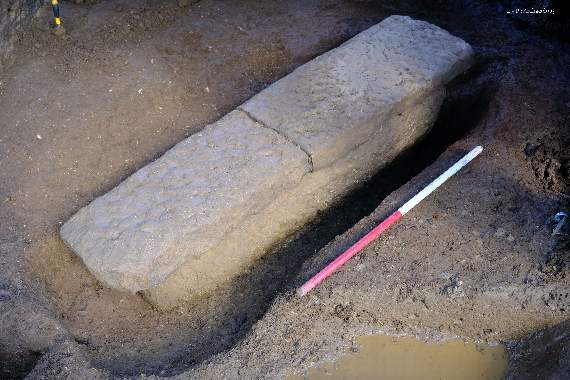
A stone sarcophagus dating from Roman times and containing two burials has been unearthed by archaeologists at Sydney Gardens in Bath.
The find is said to be a very rare glimpse into local burial practices two thousand years ago.
The coffin is a Bath limestone casket and lid containing the preserved remains of a person laid in a prone position and the partial remains of a second person laid at their feet.
It was found within a grave approximately two metres long, 60cm wide and 50cm deep and its north-facing aspect suggests a pagan burial.


A cremation burial was also recovered which is the only recorded cremation burial from the Bathwick Cemetery to date.
Sydney Gardens in Bath is a former 18th century pleasure garden currently undergoing building conservation and landscape work by Bath & North East Somerset Council and funded by the National Lottery Heritage Fund, which led to the discovery of a Roman wall.
Archaeologists L-P Archaeology who had been watching the groundworks began to excavate the area around the wall which lay on the edge of the Bathwick Roman cemetery. It was then that the stone sarcophagus was revealed.
Kelly Madigan, Partner at L-P Archaeology, said: “This is a real career highlight, it isn’t often that you come across an in-situ stone coffin complete with occupants; especially on a watching brief! The excavation by our team of specialists was a huge success and needless to say, undertaken to internationally high standards of archaeological excavation and recording.
“I’m beyond excited to find out the results of the assessment, which is currently ongoing in our labs and hope that it in turn lends itself to an interesting analysis phase where we can delve deeper into just who the people we found in the coffin were, where they were from and their health and welfare.
“Having a human skeleton directly associated with a coffin is a rarity and to have this one associated with a probable votive offering and nearby human cremation, allows a very rare glimpse into funerary practices in the region
almost two millennia ago.”
The Council is considering an option to display the empty stone sarcophagus in the Temple of Minerva in the Botanical Gardens, where new information panels about the Pleasure Gardens are due to be located.
The Sydney Gardens Project is also hoping to include interpretation about the Roman archaeology of the gardens as part of the completed project.
Councillor Richard Samuel, Deputy Leader and cabinet member for Economic Development & Resources, said: “This is a remarkable and exciting find. We have such a rich, varied and important archaeological heritage in Bath and North East Somerset and it’s important that this is properly preserved.”
The project team obtained a licence from the Ministry of Justice in order to handle and manage human remains. Under the conditions of the licence, the remains will be reinterred within a legally certified burial ground by 2026. In the meantime, while further analysis is undertaken, the remains will be kept safely, privately and decently.
Comments
This article has no comments yet. Be the first to leave a comment.