

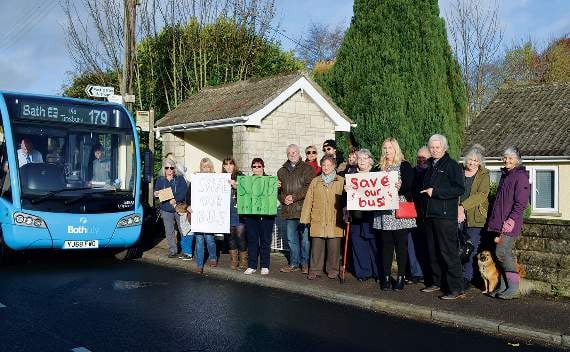
A Rural Transport Partnership is to be formed by B&NES, Parishes and local residents in a bid to address strong concerns of local people over diminishing bus services.
The new partnership, originally suggested at a Community Forum Workshop, has been given impetus by two local public meetings organised by Timsbury and Farmborough Parish Council and Dunkerton and Tunley Parish Council. Both these meetings focused on the recent reduction in services on the 179 route by First Bus, whose senior managers attended the Farmborough meeting.
As concerns were raised by residents, what became clear was that, on the one hand, the public were not aware of the structure and funding of local bus services, whilst at the same time, B&NES and the West of England Combined Authority lacked a joined-up coherent strategy on rural transport.
There were repeated questions as to how First Bus were simply allowed to cut the 179 service when they surely had a legal obligation to provide one. It was explained that there is no obligation for First Bus, B&NES or anyone to provide a service – the service is simply a commercial undertaking. Why then, it was asked, can’t First Bus, with its ‘fat profits’ just run the service anyway? It was explained that First Bus is owned by its staff, and last year made a loss.
The Managing Director of First Bus went on to explain that the 179 service, with two buses, cost £400,000 a year to run, but that the revenue amounted to £80,000. Cllr Mark Shelford, B&NES Cabinet Member for Transport, noted that B&NES did not have the money to fill the £320,000 a year gap and First Bus certainly didn’t. The issue of the falling demand was raised and countered that with reduced services, it would become a vicious circle. Late buses were cited as a reason for people not using services, but First Bus explained that road works often held up their services and there was little or nothing they could do. Residents made the case that a bus service was none-the-less vital for local people who could not drive or did not have a car – namely the young and the elderly.
As the debate progressed, it was recognised that B&NES and First Bus had done all they could by saving the 179 Monday to Friday service through transferring the Sunday service subsidy.
However, both public meetings concluded that there was no certainty that the service in question was sustainable going forward – what will happen in future?
Following short presentations from Dunkerton and Tunley Parish Council and the B&NES Council representatives, parishioners raised their concerns. These included the criteria used to determine levels of bus subsidy, how the value of bus services is measured, the reduction in the 179 service over the last year, the current ticketing regime and how it discourages use, the effect on local house prices, and the high cost of taxis as an alternative form of transport.
At both meetings, Cllr Paul Myers (B&NES Council’s Cabinet member for Economic and Community Regeneration), suggested that by getting the key players around a table with residents, the starting point should be ‘what are the actual transport needs of local people and at what times in the rural areas’ and then look at ‘how best to meet them with a range of solutions’, rather than simply thinking in terms of a traditional bus service alone.
Rosemary Naish, Chairman of Clutton Parish Council, suggested one possible solution was the idea of a new Community Bus Service. There is much work yet to be done to find out if this could be achieved. First Bus indicated their interest in being involved, and it was agreed that letters should go out to all the Parish Councils from B&NES asking for expressions of interest in sending representatives to a new B&NES Rural Transport Partnership.
Comments
This article has no comments yet. Be the first to leave a comment.