

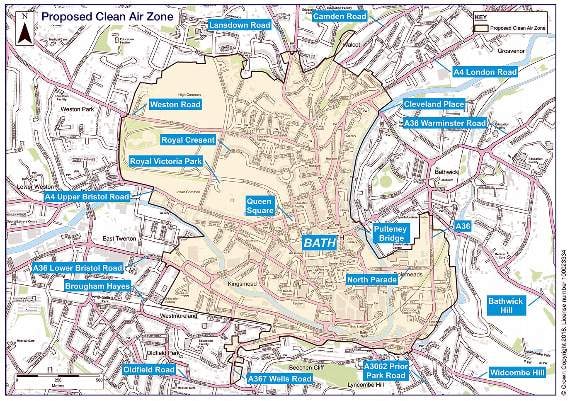
Drivers will not have to pay to enter Bath’s Clean Air Zone if a revised plan is approved, after an “unprecedented” response to a public consultation.
B&NES Council has been told to reduce nitrogen dioxide levels in the “shortest possible time”, and by 2021 at the latest.
The authority had proposed to charge all higher emission vehicles to enter the Clean Air Zone, but new forecasts show Government carbon emission reduction targets would still be met if the fees are restricted to taxis, buses, coaches, lorries and vans.
Officers have since recommended the adoption of a revised scheme, which exempts cars from the charges. This could be approved by Councillors at a special meeting next Tuesday, 5th March.



B&NES Council received more than 8,400 responses to its Clean Air Zone consultation, forcing it to delay a decision due before the deadline at the end of last year. Residents wanted a “less impactful” scheme, were concerned about the level of the charge, and challenged the council “on whether more could be done to achieve an alternative solution”.
The Clean Air Zone boundary has been altered to reduce the potential impact of rat-running, to allow vehicles to turn around safely before they enter the zone, and to cut the amount of ‘street clutter’. The Pulteney Street area of the city is now recommended for inclusion, and cabinet members are also being asked to consider including the junction of Oldfield Road and Wellsway, the Bathwick Estate and Sydney Gardens areas.
The Council is proposing to monitor the air quality and install automatic number plate recognition cameras within the zone.
Predictions show the scheme will improve air quality in most of the city, but nitrogen dioxide will be higher than the legal limit in Gay Street, so the Council would look to reduce traffic flow in the area. Under the Clean Air Zone, new traffic lights would be installed at the junctions with the A367 Chapel Row/Princes Street and at Queen Square Place, but these would be removed once nitrogen dioxide levels reduce and vehicle emissions improve.
The proposed charges are unchanged – larger vehicles will pay £100 a day to enter the Clean Air Zone and smaller vehicles will pay £9. The charges will apply to pre-Euro 6 diesel vehicles, including hybrids (older than approximately 2015) and pre-Euro 4 petrol vehicles, including hybrids (older than approximately 2006).
Cabinet papers say the income from the Clean Air Zone will reduce ‘significantly’ if car drivers are not charged, but it will ‘minimise the impacts on economic growth and development in Bath’.
The new proposals include a ‘firmer commitment to financial assistance’, with interest-free loans available to help businesses upgrade pre-Euro 6 commercial vehicles (older than approximately 2015). Companies with Euro 4 or 5 diesel commercial vehicles that are unable to obtain a loan would be able to apply for a concession until January 1st, 2023.
Other measures include extended opening hours at the Park and Ride sites, anti-idling and weight-restriction enforcement, support for revisions to residents’ parking zones, and better walking and cycling facilities.
Depending on the decision made by Cabinet, more detailed information on the scheme, including bids for funding, will be sent to Central Government.
After receiving approvals and funding needed, the Council would then begin the formal processes for implementing the scheme, including any required consultation, with the aim of having it start in December 2020. Bath is set to be within the legal limits for nitrogen dioxide by December 2021.
Cabinet members will meet in the Guildhall at 10 a.m. next Tuesday to make a decision.
Lib-Dem spokesperson on Air Quality, Councillor Richard Samuel, commented: “It’s welcome that the new proposals will not tax the poorest local residents for access to the city centre, and we are glad that concerns have been heard.
“However, it remains to be seen if the benefits of the Clean Air Zone can be fully realised without cars being included. Once the detailed background papers are published, a clearer assessment will be possible.”
Stephen Sumner, LDR
Comments
This article has no comments yet. Be the first to leave a comment.