

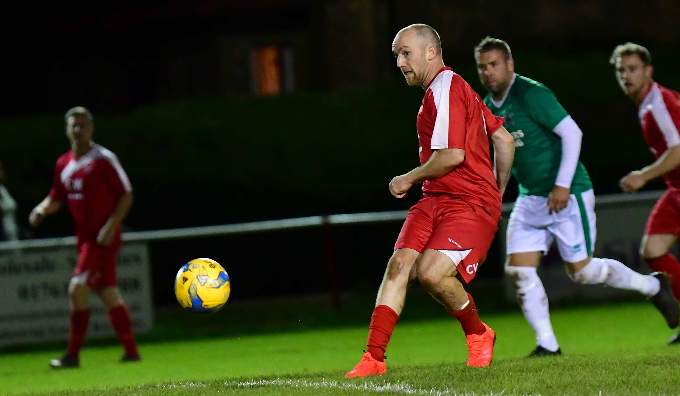
Local Sports Presenter, Ian Nockolds, interviews Miners’ Manager, Ryan Child, in the first Sounds of the Sea Podcast for 2022 and shares his transcript on the possibility of an emerging Covid culture of cancelling games if you can’t field a team, and how he is not only managing a football side, but also a kidney condition.
Ian Nockolds: “Did you have a pleasant Christmas and a Happy New Year Ryan?”
Ryan Child: “I did, thank you Ian. Apart from football, everything’s great.”
IN: “Did Santa bring you anything particularly exciting in his sack?”


RC: “No, just socks, and it was my daughter’s first Christmas. So, lots of Grandparents looking after the kid and a little bit more free time than usual, so it was good. And I just spent most of it worrying about what formation we were going play.”
IN: “I can understand that, given the events of January 2nd. It was a difficult day at the office, I think it would be fair to say. On the grounds that you were taking on Wincanton, I think we can safely say that you weren’t at the races?”
RC: “Yeah, that would be a mild way of putting it. We just didn’t do well in those games over Christmas; the two games, the Sherborne game and the Wincanton game, for quite a lot of different reasons. The results were bad. But it was quite obvious what the issues were, it wasn’t any great mystery. We’ve had a lot of injuries, player unavailability and so we’re looking at it thinking, ’Okay, look, we’ve got the games played, not good results, but at the same time, you know, we’ve got our target still, and we’re still on course to get there. So, we just have to kind of keep at it really and stay positive.”
IN: “To be fair, you had three wins on the bounce before the Sherborne defeat, so it’s not all been doom and gloom, has it? You’ve managed to pick things up a bit.”
RC: “Well we’ve been quite a streaky team. So, I think we went about twelve unbeaten, had a few weeks off with Covid and then lost a couple. Then went on a run of winning three, actually, we were winning a fourth game, but that’s the one that got called off against Tytherington Rocks, when, for the first time in my career as a player or a Manager, the lights went out. And what was quite funny, is one of our players who got red carded, actually, happens to be a sparky. So, the ref said: ’Look, you’re not allowed anywhere near the pitch but if you could go and check the floodlights out, that’d be great.’ So, that’s pretty classic non-league really, and he had look, and sadly, couldn’t do anything on the pitch or off it that day. So, we had to abandon that one, but we were winning quite comfortably.
“There’s a lot of positives in the season so far. It’s been a really tricky season with all the unavailability, Covid, all that type of thing, and we’ve kind of taken these two games that have happened as ’okay, it’s time to reset, have a little think about what we’re doing.’ And kind of go on, have a look at where we are in the table and push forward from now onwards, really.”
IN: “You’ve talked there about the player availability issues and that’s been a theme of our previous conversations. And you also mentioned the dreaded Covid, which is obviously still rife across the country, let alone non-league football, but I suppose on January 2nd, the other factor that kicked in, to be fair, really, for the first time this season was the Great British weather. Of course, that’s always been the real problem in the old normal, and it reared its ugly head and by the end of that game - your pitch was in a terrible state, wasn’t it? I mean, that really has played havoc with the Southfields pitch.”
RC: “I was talking to their Manager at half-time, and the score’s 4-1, so we’d had chances, Wincanton had put all their chances away and taken nothing against them, they were really clinical. They got us on the break three times and scored three really good goals. And then there was another goal! But he said to me, ’You know what, there’s probably four more goals in this either way’, it was just absolutely all over the place because of the conditions. So, again, it is one of those where we have to be not necessarily negative, we can’t look over what’s gone wrong. We’ve done that in training - we’ve looked at, ’okay, what can we do better as a team?’ Because when you get beaten by that many goals, obviously, it can’t just be the conditions, it can’t just be player availability. It’s got to be something else. So, we’ve had a look at that and we’re pretty happy that we can rectify that. But like you said, the pitch was a mitigating circumstance, there’s no doubt about that. I mean, it was just an absolute ... There was one time where a player went in for a tackle, he went to the ground on their dugout, and he slid all the way along the bar line and went past ours! We kind of waved as he went past. That’s as bad as that pitch has ever been, and I’d said before the game to the Chairman, Si [Simon Wilkinson], he does such a good job of getting the pitch sorted, I said to him, ’this is the best this pitch has looked at this time of the year, it looks absolutely brilliant.’ You know, then an hour and a half later, it was probably the worst it’s ever looked.”
IN: “The worrying thing is the impact that it’s going to have on upcoming fixtures, because the weather hasn’t got any better this week. In fact, if anything, it’s got decidedly colder, and a lot damper. And you have got, obviously, Bishop’s Lydeard as your next scheduled home game; you’ve got four games, actually, at home in the month of January. What are your feelings about how those games are going to get on? And if you do get them on, you’re going to have to learn something from that Wincanton performance, because you’re not playing on a bowling green, are you?”
RC: “No, and that’s been not just since I’ve been here, but probably Radstock Town’s problem for the last couple of years, is that we are a good footballing team, we have the ability to pass a team off the pitch, no problem at all. But how do we play when it gets a little bit more difficult out there? How do you play the conditions? And again, that is some of the things we’ve been talking about in training, and I think the players realised that it’s just playing a little bit more kind of clever, neat Western League football where you’re playing a bit more percentages. We’ll have to look at that with the games coming up, particularly that game against Welton where they’ve proven themselves this year. I’ve spoken to other Managers about their run and I think every Manager has said, ’not the best team in the league, but probably the most hard-working team in the league, and probably the team that knows how to play the game, the best.’ So, they’re playing percentages really well, they’re very physical, they’re aggressive. And, you know, if you don’t match teams just on those basics in this league, in some ways, it doesn’t really matter how good you are at playing, because you’ll just get bullied off the pitch. And I think that’s probably what happened if I’m completely honest, against Wincanton and to a degree, against Sherborne as well, they’re two teams ... and Sherborne we beat earlier in the season, we were much more physical when we played them. And on the Boxing Day game, we just didn’t go in with that mentality. And I think that’s something that we need to address as a team if we’re going to compete with that, probably that top three.
“I think, after that, we’re probably up there with that level, kind of fourth downwards in the league, but that top three, I think they are on another level at the moment with their physicality and like you said, the way that they play the league, they’re just a bit smarter.”
IN: “Well, you say the top three, but of course Warminster are up there, along with Sherborne, Welton and Wincanton. So, in a way, the difficult results against Wincanton and Sherborne, there’s no disgrace in that because of course, those teams not only are they riding high in the league, actually, in terms of their form, they’re going incredibly well.
“We have to say that you had a good result recently against Odd Down who’ve also been on a good run. In fact, you were the last team to beat Odd Down, so there are positives. And I think that gives the fans optimism going into the next few games. I think it’s important that we highlight the game on the 26th of January, which is the Welton Rovers game, the game that was rescheduled.
“I know that there is an element of disappointment that that game didn’t get on on Boxing Day. But I think that Radstock Town as a football club gained a great deal of plaudits across the League for the fact that actually, although you weren’t able to play Welton on that day, you did make the effort to play a game, you travelled to Sherborne. I mean, from a Manager’s perspective, were you pleased with that decision.”
RC: “In hindsight, no, because you lose the game and you think, ’well, I should have just not played.’ In foresight and actually reflecting on it, yes, and the reason is because we’ve got quite a young team. And I’m quite keen for them to learn, before this season, if they’re not going to do well in a game on Boxing Day, to kind of understand the reasons why, and to look at it. So, next year they can learn from that, and they can improve, and they can understand the types of things that they need to do on and off the pitch so that they can be consistent, and they can get results. So, I think it was a good learning curve, but then the players have to understand they have to learn, they have to learn from potentially some mistakes that they’ve made. But then in hindsight, of course, you look at it and say, ’well, we had the chance to not play the game, Sherborne are flying, we had players unavailable.’ So, it was probably a 50/50 decision. The result didn’t go our way, but if we learn from it, then it’s not really an issue.
“It’s been difficult because for the last two years as a player, we haven’t finished a season and I’m so keen just to get the games done and just to finish the season and I am wary of stepping away from games when we can play football. I think that there’s been more of a push with clubs to look at actually not playing games if they’ve got the chance to and I think Covid has kind of created that culture where if it’s easy to pull off a game, if it doesn’t quite suit you, ’okay, well, let’s just not play and let’s just look at it another time.’ And that never used to really be the culture, it used to be the whole point of playing football was to play football games. And then if you’re going to have to play Reserve team players, then play them, if you’re going to have to play Under-18s, you know, that’s why you’ve got a structure in place, you’ve got Under-18s, and you’ve got Reserve teams. So, when our game was called off on Boxing Day, I struggled to understand it with a club who’s got fifty players registered, why you can’t field a team to play a game. And I find that’s tricky for me to understand. We played Boco a few weeks before, and we had seven First team players unavailable; five of them through Covid, one suspended and a couple injured. And by seven First team players, I mean, seven starting players. And we played the game, and we managed to get the result, and by the way, we got away with it.
“Boco were brilliant, and we defended for about eighty minutes, but it was a brilliant result, and one of the best, certainly, of my managerial career. I was very proud of the players for coming in, Under-18s coming in, Reserves coming in. And that’s what it’s all about, you give people chances, and you kind of crack on and get on with it. And that’s always going to be the culture that I’m going to have, I’ve definitely had it as a player, definitely have it as a Manager. And so, you know, with those ideals, how do you then say, ’no, sorry, we’re not going to play Sherborne, do you know what I mean? It’s not like you’re scared of playing football, so yeah, it’s tricky, but I am not a fan of the culture at the moment of teams just kind of ducking out of games. And I think that that does happen far more than it used to, and I don’t really want our club to kind of be a part of that, I’d much rather just crack on and play the games.”
IN: “Because it’s a bit of a false economy to what you’re talking about, because of course, the games that aren’t going to be played over the Christmas period, in the winter period, will have to be played at some point in time, unless things do get really bad with Covid. And I think, actually, the signs are that we’re going to get through this season. Now, that will mean that in the last couple of months of the season, teams could find themselves with quite a fixture backlog. And then of course that will raise its own complaints. But actually, it’s all part of the consequence of postponing games at any time of the season, isn’t it?”
RC: “Yeah, absolutely, and we’ve had that. I mean, a couple of years ago, because of the weather, I don’t think we played a game in February. And we ended up playing, I think it was something ridiculous, it was a lot of games in about two and a half weeks, we were playing. We played three in a week, we played Monday, Thursday, Saturday, or something like that. It was just completely ridiculous, and you know, good luck with that. But then looking at our schedule, it’s really difficult because we played a lot of games in August, at the moment, after a reschedule this week, we’ve got one game in February scheduled. I think it’s really difficult to work out scheduling in a Covid season, full stop, and I don’t envy the person who has to organise it all. But at the same time, as a Manager, I’m looking at it thinking, ’well, where’s the logic in some of these decisions?’ But it is difficult, I do understand that.”
IN: “Just before we wrap up for another week, I am following you on social media and I was interested to read a post that you wrote about a kidney condition that you suffer from. I see that you’ve written a number of articles about what that’s been like for you, and of course, that references the impact that the condition had on you while you were actually still playing football. Now, I’m going to struggle to pronounce what this condition is called, so, I’d like you to do that for me. But I just thought, for those people listening, just to give a bit more of an insight into not only your personal background, but from the articles that you’ve written about this, and I have to say they’re incredibly well written, incredibly vivid language and I would recommend that anybody go and read what you’ve written because it’s a fascinating insight into what life with this condition is like. But can you tell people who aren’t familiar with that condition a bit about what you’ve been through?”
RC: “Well, it’s called IgA nephropathy. It’s actually an autoimmune disease. I was born with it, didn’t know I had it and then in 2019 it just cropped up and started killing my kidney. It’s actually a good job I was playing football because that’s what made me realise there was something wrong with my body. I was playing games and getting absolutely just awful cramp. I remember playing against Yeovil and in the 90th minute, and this never usually used to happen to me, I literally couldn’t walk. And it was going to extra time, we went to penalties actually. So it was a godsend that I did go off, because I hate taking penalties, I’ve missed a couple for Radstock, so it was a blessing. But I started noticing that, went into the doctors, etc. And yeah, it turned out that out of nowhere, my kidneys, basically, we’re getting attacked and had failed. It was probably three months; I went from playing Western League football to not being able to play at all. Obviously, I was quite open with the Chairman, and it just so happened also that the Manager stepped down, so then I obviously wanted to stay involved and this has kind of formed this way. But it has been difficult, they’ve just started me on a dialysis treatment now. So, I have to do that three times a day, so alongside football, it can be difficult. But it’s also been a brilliant distraction, because anyone who manages a team knows that it’s pretty much a full-time job, or it can be, plus the full-time job that I have. And I’ve just had a daughter as well, all while this happened, so I have been nicely distracted, you might say, during this whole time. But my background away from football is in journalism and so I’ve managed to try and do some creative stuff with it, just to kind of share it. And it’s had a really good response on social media with people that suffer from other rare diseases. And so, I’m just going to try and see the positives, hopefully get a transplant, but it’s quite long winded and it’s quite difficult at the moment. But you just have to kind of stay positive and just impart what wisdom you can on some of the players if they’re having tricky times. Not that most of the time they listen to me - if I’m perfectly honest!”
IN: “What sort of impact has it had on your life, going from a position where you didn’t even know you had this condition to obviously one now, you’re talking about dialysis treatment. And I know you’ve written about the pills, the cacophony of pills, that you’re subjected to on a daily basis. So, what impact has it had on the way that you live and the way that you eat?”
RC: “Well, when I was very first diagnosed, I went vegan. That definitely did work, it made me feel a lot better, but you do have to stay on a low salt diet. The pills, they put me on steroids, which was really difficult. So, over last Christmas, my face swelled up and I was still taking training and I was very keen to stay involved with football. And you didn’t know if the players had noticed that you look a little bit different. I was very, very tired, so I was having to take naps in the day, and I was working sometimes at midnight, my boss kind of just said, ’work when you can.’ I was waking up, couldn’t sleep, so I was working like midnight to four in the morning, then sleeping a bit in the day and doing football training at night. I’ve tried to stay busy, and I’ve been to just about every training session, I’ve probably missed one or two to have to go to the hospital. But I think, you know, you just have to kind of keep cracking on with everything and not allow things to slow you down or get in your way too much. Because then it becomes like it rules you, and you can’t really allow it to do that, you have to just kind of push forward. So, the pills are a bit disgusting, the steroids were absolutely terrible, they were talking about putting me on chemo treatment as well which would have been more difficult. To be fair, Ian, I lost my hair, or I have been in the process of losing my hair over the last four or five years. So, aesthetically, it probably wouldn’t have done much. Although I do have eyebrow hair at this point, so I’m dying to keep that. In the end, we didn’t have to do that but, you know, the treatments are difficult, but you can’t let it affect your life too much, like I said, because it’s just not an option.”
IN: “Well, it’s a fascinating story and it may be one that we return to in the future but thank you for sharing that with us. And hopefully, things will improve on the field, if indeed we can get on the field in the month of January, but I look forward to catching up with you again soon, Ryan. Thanks for your time.”
RC: “Absolute pleasure, thanks Ian.”
Comments
This article has no comments yet. Be the first to leave a comment.