
WE enjoy the signs of spring as they gradually appear, whatever the weather.
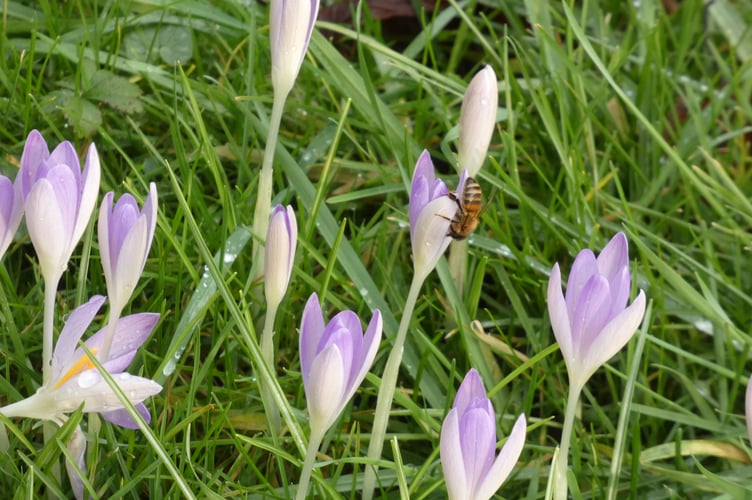
Crocus tommasinianus easily naturalise in grass and pop up across the lawn almost overnight. There were lots on our lawn in February, though little sunshine to allow them to open up and provide early nectar, however I did manage to get a photograph of a honeybee taking advantage one rare sunny afternoon. Tiny Cyclamen coum are less affected by the dull weather and although it takes a few years, spread far and wide by means of seed pods that spring open to distribute their seed. What a joy to see, when patrolling a cold and wet garden looking for signs of life.
It is my aim to increase my winter flowering shrubs. The Witch Hazel had come out beautifully this year, whereas its flowers have been a bit sparse in the past. I did congratulate it on how well it had done – yes of course I do talk to my plants, an encouraging word is often needed. Winter honeysuckle had also attracted a few honey bees, but it is a straggly shrub and whilst scented not particularly attractive. Likewise the Cornus mas shrub I bought. I had seen a magnificent large specimen full of bright yellow flowers for £180.
It was nice, but its beauty would be unappreciated down in the orchard. By chance elsewhere, I found a damaged specimen, its leader stem snapped off, but the bees wouldn`t care. Wonky it was, but it was flowering and cost me less than a fiver. What a bargain. Forsythia, Witch Hazel and the first primroses joined the early yellow blossoms and snowdrops clothed the bank of the brook, which at times turned into an impressive torrent across the orchard as the water overcame the underground pipes. In the veg garden, the poor old Brussel sprouts produced lots of sprouts, but never grew to any size. I kept thinking I’ll wait until they’re bigger before I pick them, but I have a feeling the little green marbles are maybe all I’m going to get.



It must be spring as the ladybirds in the bedroom window start to appear crawling over the window sill. I open the window to let them out, and a few manage to crawl in the right direction. In the autumn they squeeze in between the window and the frame, so when I have to close the window that night, I shut it with great caution less I should crush any little bodies.
More action on Chew Valley lake. There was I’m told, a male American ring-necked duck visiting and that was the centre of attention.
Back home, the trays of seedlings mount up and I am on constant mouse watch since I had to move them out of the kitchen to the cooler garden room. Mousetraps are needed I’m afraid.
A relative in Queensland, Australia tells me how they are worried their water stocks are low and are desperate for rain – I tell her she can have some or ours, plenty to spare here.
Comments
This article has no comments yet. Be the first to leave a comment.