

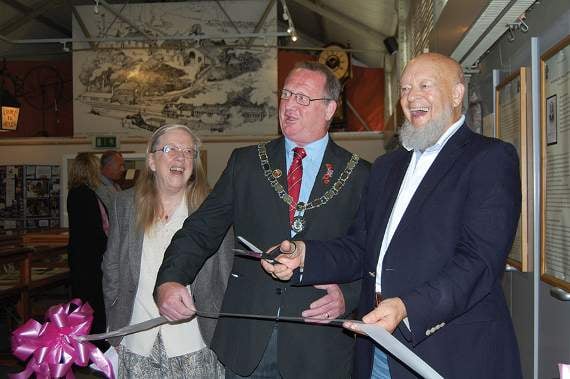
Michael Eavis continued his support of Radstock Museum when he opened the fifth in the museum’s series of Communities and Villages exhibitions last Saturday.
Westfield residents have pulled together the many threads in its long history, which stretch from the Romans’ building of the Fosse Way, through the quiet years of agriculture, to the explosion of coal mining which supported varied minor industries, to today’s flourishing small businesses and entrepreneurship, and the creation of its own civic parish in 2011.
Starting with the infamous Roman Fosse Way, laid around 1,800 years ago and passing straight through Westfield, the exhibition moves forward through the Parish’s varied history, with mining playing a huge part in shaping the character of the area and the heritage of its residents.
Indeed, records show that from the time industrial coalmining was established in 1763, through to when the mines closed, over 10,000 men and boys had been employed in the local pits. Two of the most infamous pit disasters happened in Westfield, and many of the pill boxes – built as an outer defence perimeter for the pits – still stand today, and can be visited on the Westfield Heritage walk.


Does anyone remember the iconic elm tree that stood near the centre of Westfield? Some said that it was haunted, and one account from 1875 reported that “three of us could walk into it upright and gaze straight up to the leaves above.”
The exhibition details the history of the four different church traditions in Westfield, as well as the seamless shift in industry; from the closure of the mines to the growth of such well-known businesses as Clarks, Prattens, Mardons, Edgell’s, Charlton’s and Mitchard’s. Did you know that the airless tyre was invented and produced in Westfield? This and many more artefacts will be on display.
Exploring the war years, the exhibition presents stories of those who lived and worked in the Parish, including Downside monk and priest of St Hugh’s, Fr Joseph Coomb-Tennant, who won the Military Cross and went on to a career in MI5, before becoming a monk.
Residents will find fond memories of other local characters, such as Cllr Ivy Young, and the extraordinary wartime achievements of Edward Greenman R.N, which could create an exhibition in themselves. Throughout the museum display, visitors are encouraged to share their knowledge and identify faces in photos.
Finally, recreation and ecology – what would Westfield be without its beautiful recreation grounds and expansive Waterside Valley? Purchased by the Miners’ Trust, two plots of land were set aside for leisure and recreation, and continue to be used for football, tennis, boules and children’s play areas today.
History is not only what we can remember and record, and Westfield residents did not sit around waiting for events to unfold; they used their ingenuity to make things happen.
Delving back into our ancient Roman history, right through to the present day, the exhibition is interwoven with the personal stories of Westfield folk who made this a community of which they can be proud.
The exhibition runs at Radstock Museum until Wednesday, 29th November.
Comments
This article has no comments yet. Be the first to leave a comment.