

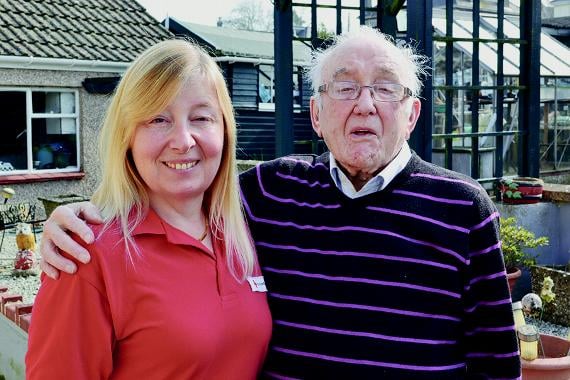
When his wife, Audrey, died in 2015, Desmond Gregory’s world fell apart. After nearly sixty years of marriage, the 89-year-old from Midsomer Norton was suddenly alone.
As time passed, Desmond found he was spending more and more time by himself.
Despite his daughter visiting regularly, his grief was overwhelming and he began to feel increasing lonely.
He said: “Some days I didn’t see anyone at all. I miss my wife a great deal. I miss going to work. I just miss having company.”



Before his retirement, Desmond worked as a cutter at the Clarks Shoe factory for 37 years. He had met Audrey when he was 24, after a motorbike accident left him in hospital for three months. Audrey was his nurse.The couple moved to Midsomer Norton from Chilcompton when their daughter was a baby in 1959. They enjoyed gardening together and craftwork – Desmond spending time in his woodwork shed, and Audrey sculpting sugarcraft animals and flowers or cake decorating.
The home that they had spent almost sixty years making together suddenly seemed very empty without Audrey in it.
Recognising that Desmond was lonely and becoming isolated, his healthcare worker introduced him to the British Red Cross Support at Home service.
The service, which is funded by Land Rover, provides up to six weeks of support to older people in rural areas around Bath and north east Somerset. During weekly visits, Red Cross volunteers work with service users to identify their own goals, helping them to regain their confidence and independence.
Sarah-Jane Morris, a
support worker for the service, began making weekly visits to Desmond. She explained: “When I first met Desmond he was very low and clearly missed his wife a great deal. Bereavement can be one of the main triggers for loneliness, and so after Desmond and I looked at his needs, it was agreed that it would be good for him to get out and about to find ways to overcome the isolation he was feeling.”
Every week, Sarah-Jane would take Desmond out for a couple of hours. On one
occasion, they visited Radstock Museum, which Desmond thoroughly enjoyed. He said: “My father and my brother were both miners. Dad spent fifty years underground, so it was very interesting to visit the museum and have a glimpse of what their working life was like.”
On another occasion, Sarah-Jane took Desmond to visit his brother, as it had been some time since they had seen each other due to health problems. He adds: “It’s a marvellous service. Each week, Sarah-Jane would let me choose where I would like to go the following week. I’d really look forward to her collecting me and would always be ready on time to make the most of it. Just going to the local farm shop for a cup of coffee was nice, because it got me out of the house for a while.
“Obviously I still miss my wife a great deal and still get a bit low, but the visits picked me up a bit. Knowing I would be seeing someone and would be going out gave me
something to look forward to. Getting out of the house lifts my mood.”
Over the six-weekly visits, Sarah-Jane has seen an improvement in Desmond. She said: “Encouraging Desmond to get out of the house has helped him focus on other things. He’s certainly much more talkative now than when I first met him.”
To help Desmond keep connected to his family and friends, Sarah-Jane encouraged him to sign up to a four-week ‘iPad for Beginners’ course at the local library and run by the Well-being College.
Sarah-Jane also introduced Desmond to the Age UK Befriending service, so he will continue to receive weekly visits after the Red Cross support comes to an end.
He now makes sure he gets out of the house every day, taking his mobility scooter to the local shops and having a chat with his neighbours. He said: “The Red Cross service is really very good. I’d definitely recommend it to others. Sarah-Jane is a very nice lady who really looked after me. We’ve enjoyed each other’s company a great deal.”
More volunteers are needed to join the Red Cross Support at Home service in Bath and North East Somerset to help lonely and isolated people re-engage with their community. Support can include shopping or light household work and help to gain access to and engage with local services and activities. The support is aimed at improving people’s confidence, health and well-being and building their social networks.
If you want to find out about volunteering with the service, please contact Debbie Rushton, service coordinator on: 0117 301 2604 or email: [email protected]